Author: Laura Swatton

Growing Together: Investing in You, Us, and Our Product Partners
Growing Together: Investing in You, Us, and Our Product Partners
We’ve been listening to your feedback…
Evoke Telecom started back in 2013, and like many in the telecoms industry, it’s been quite the ride. Technology has changed fast, sometimes slow, and occasionally done a full loop-the-loop. That constant change has shaped how we do business too.
But one thing has never changed: our belief that the best way to help a business grow, yours, ours, or anyone’s, isn’t just about providing great technology. It’s about listening to the people who use it and actually hearing what they need.
Over the last couple of years, we’ve been doing a lot of that listening. And those conversations have shaped where we’re investing next, in our services, our platforms, and the partners we work with.
Our latest update, and some coming soons…
Investment isn’t always about shiny new things. Sometimes it’s about making your every day-to-day a little smoother.
Launching soon…
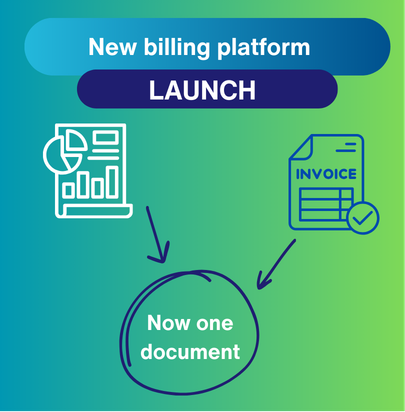
In April 2026, we are launching (launched depending on when you are reading this!) a brand-new billing platform that brings your invoices and reports into one document, sent out at the beginning of each month. It’s easier to navigate, and designed to give you back time, time you can spend on your own growth rather than chasing paperwork.

And there’s more on the way:
We’re currently putting the finishing touches on a brand-new ticketing platform for our engineers and service teams. It’s coming soon, and it’s going to make getting the support you need even faster and smoother.

And there’s more on the way:
We’re even looking inward at our own CRM. We’ve used Zoho for a long time and we’re happy with it, but we’re asking ourselves the same questions we ask for you: is there something even better out there? The answer is likely yes, so watch this space on that front too!
What else is new?
There’s no avoiding AI right now, and honestly, we’re here for it. We see it as a teammate rather than a threat, a way to help your team work through that never-ending to-do list a little faster. The goal is to automate the repetitive stuff so your people can focus on what they’re actually good at: building relationships and solving real problems.
To make that happen, we work with partners who offer more than just great products. The technology matters, of course, but so do the people behind it. When we bring on a new partner, we look at the company as much as the product. If it doesn’t feel like the right fit, that’s usually a sign to walk away. We naturally gravitate towards people who share our values, and we think that comes through in everything we do.

Right now, our product partners are helping us lead the way in two areas:
Smarter sales communication — We’ve partnered with innovators who provide browser-based, AI-powered tools designed to shorten sales cycles and keep teams connected across any device, without the headache of complicated software.
Intelligent voice and analytics — We’re working with cloud specialists to bring you AI agents that can hold genuinely human-like conversations and give you real insight into how your customers and team are feeling. Not just automated responses, something much more capable than that.
Whether it’s a tool to strengthen your sales pipeline or a smarter way to connect your systems, we choose products that act as a common thread, pulling your business together rather than adding more complexity.

A partnership, not just a provider
At the heart of all of this is something pretty simple: we’re a team of people who genuinely care about your success. We don’t believe in one-size-fits-all solutions or pushing technology for the sake of it. We keep up with the market so you don’t have to, and we’ll always point you towards what actually fits your business, not just what’s new.
We have some exciting product releases coming up, and we’d love to hear your thoughts, or better still, what you actually need from us.
Thank you for being part of the Evoke journey, whether you’ve been with us from the start, for a few years or you’re just getting to know us. If you ever fancy a proper conversation about how we can help, we’re always here.
Let’s see what we can build together.

If you have any questions or feedback just let us know.

Beyond the Voicebot: Why AI Voice Agents Change Everything
Beyond the Voicebot: Why AI Voice Agents Change Everything
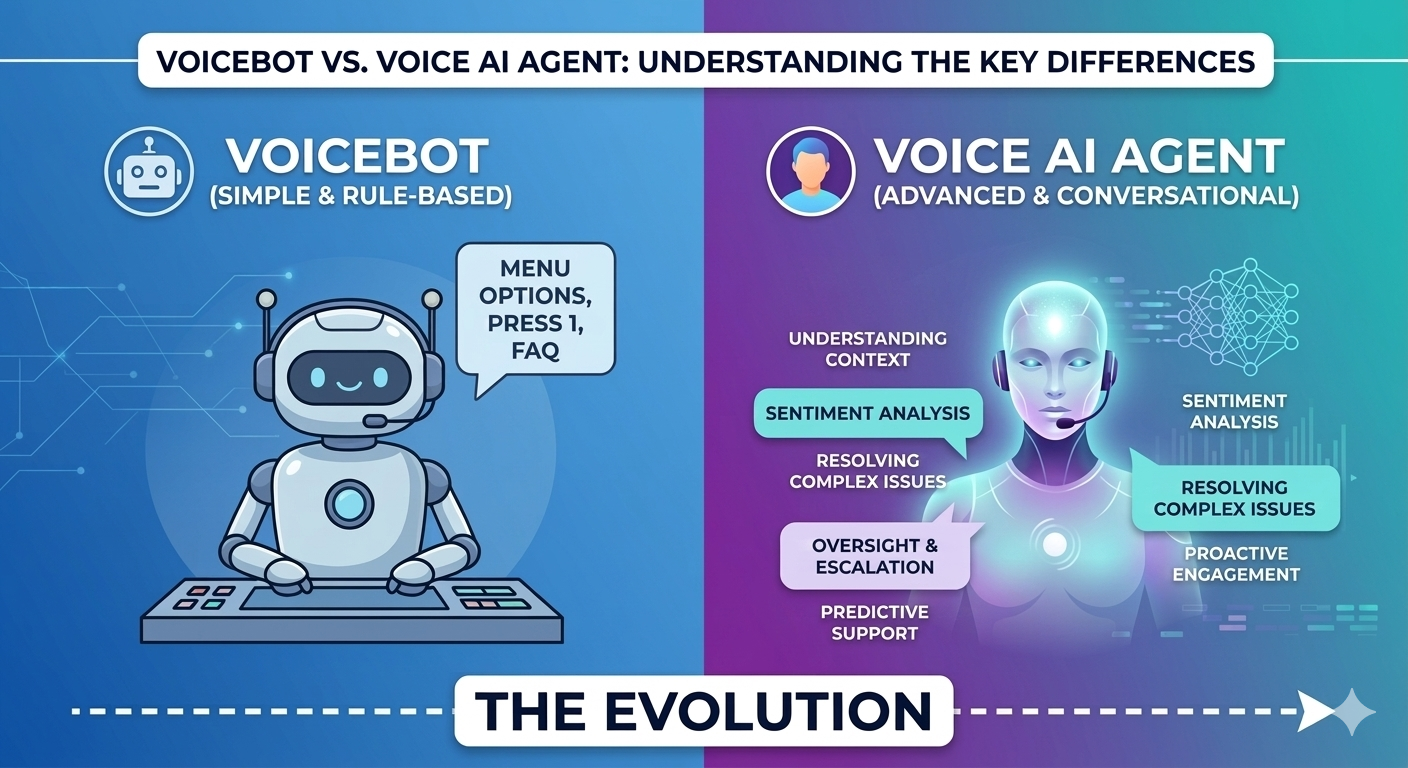
AI voice technology has split into two very different generations. On one side are voicebots, the static, rule-based systems most callers know all too well. On the other side are AI Voice Agents, intelligent, adaptive systems capable of understanding context, reasoning, and taking real actions across business systems.
This isn’t an incremental upgrade. It’s a complete rethink of what automated voice can actually do.
Voicebots vs Voice AI Agents, let’s take a look
Voicebots: Useful, but Limited.
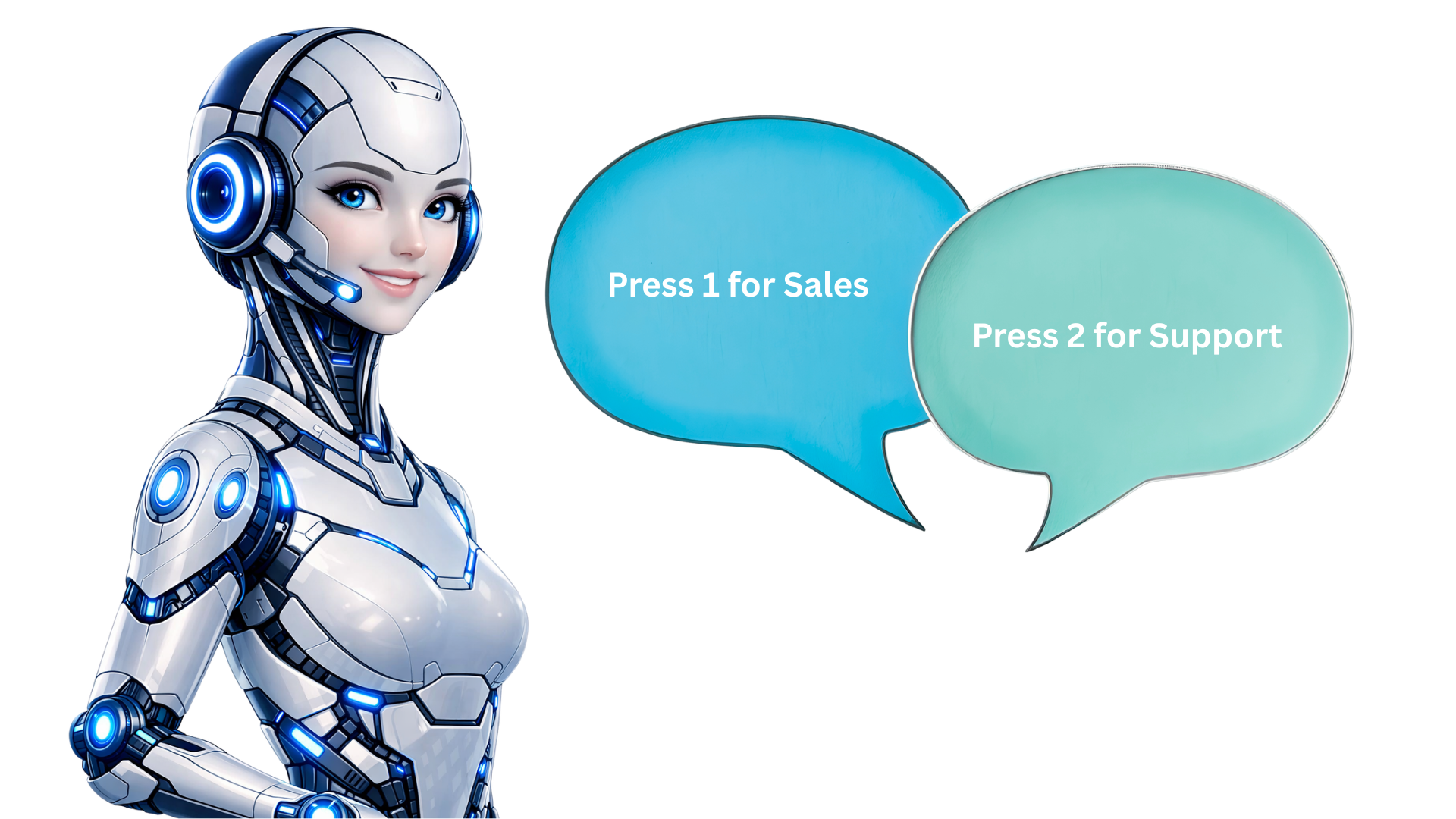
Voicebots weren’t badly designed, they were designed for a simpler era, when customers didn’t expect as much as they do now. They follow predefined scripts and decision trees, and for predictable, routine tasks, they do the job. Answering FAQs, routing calls, and capturing basic information.
The problem is what happens when a conversation goes off-script. A caller who interrupts, asks something unexpected, or needs two things at once. A voicebot can’t adapt, can’t think beyond its boundaries, and can’t take any meaningful action. That’s when the frustration kicks in, and why so many people still dread calling automated systems.
AI Voice Agents: A Whole Different Conversation
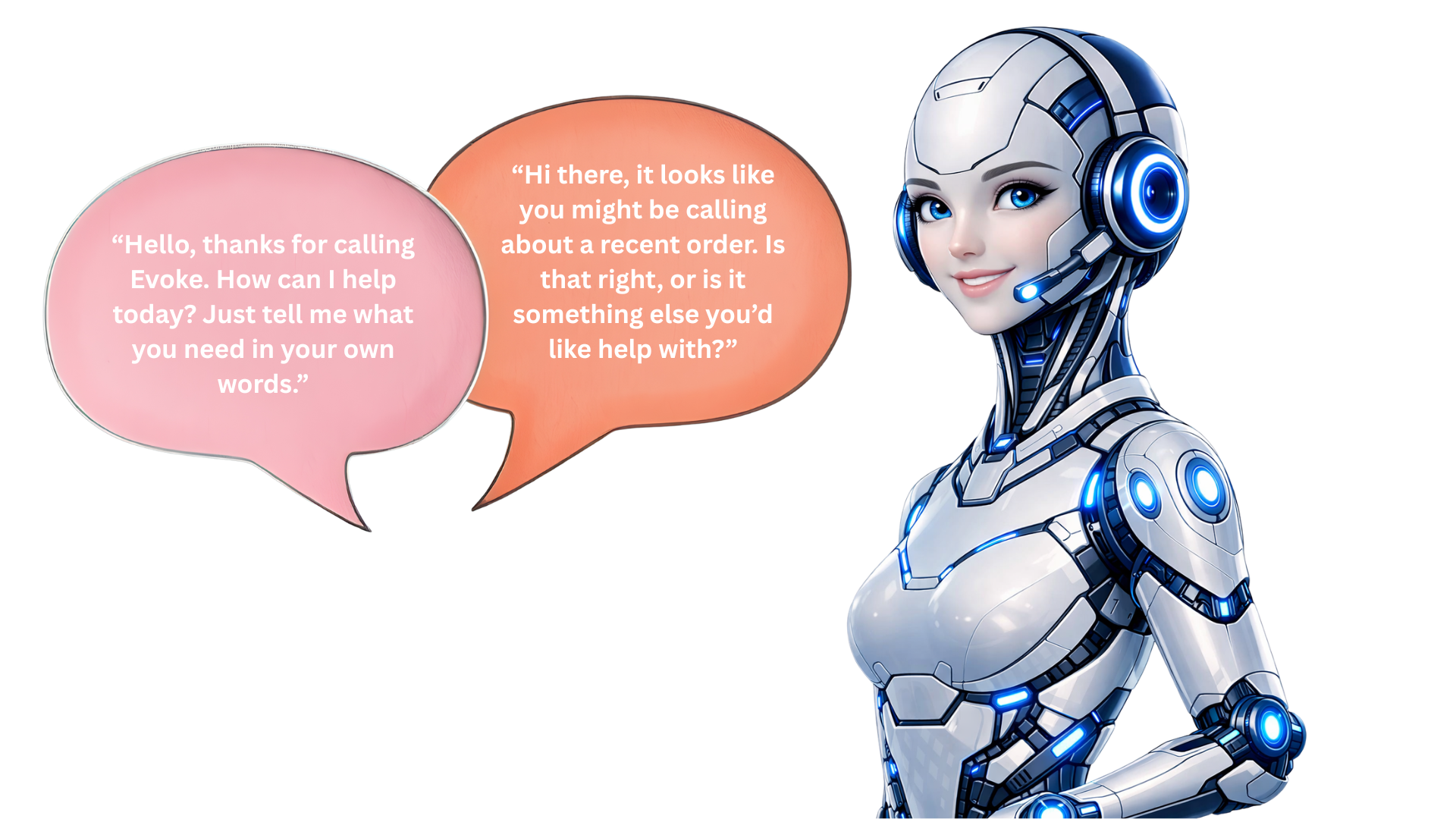
AI Voice Agents are technically still “bots” but what’s behind them is entirely different. They’re built on large language models with access to vast, structured knowledge bases, which means they can genuinely understand what someone is asking rather than just matching keywords to scripts.
They can hold a proper back-and-forth conversation, ask follow-up questions, interpret complex requests, and actually do something about them, updating records, processing claims, sending documents, all mid-call. They can even translate languages in real time, so a caller who isn’t comfortable in English can still get the same quality of help.
It’s the difference between a machine that answers and a system that actually resolves. A solution that wins for both the caller and the business themselves.
Recent industry research reinforces how rapidly voice automation is evolving:
AI is accelerating across customer service at a pace that would have seemed unrealistic just a few years ago.
Salesforce’s 7th State of Service report shows that AI is expected to handle half of all customer service cases by 2027, up from around 30% today, based on a global survey of 6,500 service professionals. Nearly four out of five service leaders now say investment in AI agents is essential to meeting business demands.
Businesses are not adopting this technology because it is fashionable. They are adopting it because it delivers beyond basic scripted automation toward intelligent, context-aware systems capable of managing complex, multi-step interactions at scale.
The reason is not cost alone. It is a capability.
Traditional voicebots were designed to automate the predictable. AI Voice Agents are built to manage the unpredictable and that is where modern customer service is won or lost.
Businesses that make the shift benefit from higher first-call resolution, genuine 24/7 intelligent coverage, reduced pressure on human teams, and the ability to automate complete customer journeys rather than isolated tasks. Just as importantly, human agents are freed to focus on the conversations that truly require empathy, judgement, and reassurance the moments where a real person makes the greatest impact.
AI Voicebot
AI Voice Agent
What a Voice vs AI Voice Agent Looks Like in the Real World:
Picture calling about a travel insurance policy and asking: “Does my cover include delays caused by airline strikes and can you email me the documentation?”
A voicebot can’t handle that. It’s two things at once, requires policy interpretation, and needs to trigger a follow-up action. An AI Voice Agent can do all of it within the same call, check your policy, interpret the relevant clause, give you a personalised answer, send the documentation, and log the interaction automatically.
Or imagine calling your motor insurer at 2am after a minor accident. An AI Voice Agent doesn’t clock off at 5pm. It can start your claim, arrange recovery, walk you through the next steps, and keep the line open for as long as you need, in whatever language!
What Customers Actually Want
Customers aren’t anti-automation. They’re anti-frustration. They want to feel understood, get their issue resolved without repeating themselves, and speak naturally rather than navigating endless menus.
AI Voice Agents deliver that. Voicebots, at their worst, deliver the opposite.
The Bottom Line: Voicebots follow scripts. AI Voice Agents understand context. One answers; the other resolves.
That difference isn’t about technology, it’s about how your customer feels when they hang up. Our goal is to ensure they feel helped, not frustrated. Whether you prefer an all-in-one system or a more flexible setup, we offer both paths so you aren’t locked into a single way of working.
Want to meet our friendly AI assistant or just chat about what’s possible? Get in touch today.

AI in Business Telephony: Why Voice Communication is About to Get Really Interesting
AI in Business Telephony: Why Voice Communication is About to Get Really Interesting
Phone calls are now more valuable, and here’s why…
Remember when everyone said email would kill the phone call? Then messaging and online chat would finish the job? Well, here’s a plot twist: artificial intelligence isn’t putting the final nail in the coffin of business telephony. It’s actually making phone calls more valuable than they’ve been in decades.
Looking back, traditional phone systems were pretty basic. They recorded calls, stored them somewhere, and that was about it. Maybe someone would listen back if there was a complaint. Most of the time, those recordings just sat gathering digital dust.
AI changes everything. Suddenly, every conversation becomes useful, and easily accessible.
Call Summaries That Actually Save Time
Gone are the days of sales teams typing up call notes. It’s tedious, and let’s face it, things can easily get missed. When you stare up at that wallboard looking at your call stats, everyone’s rushing to get to the next call.
So we welcome AI call summaries that handle this automatically. Every call gets a clear, readable summary of what was discussed, what was agreed, and what needs to happen next. Your team can actually focus on having good conversations, building relationships instead of frantically scribbling notes. This is important for several reasons, but from a budget perspective, it’s cheaper to retain a customer than it is to do the legwork to get a new one!
The best part? Nothing gets forgotten. That product feature the customer mentioned in passing? Captured. The delivery date they’re worried about? Noted. The competitor they’re also talking to? Right there in the summary.

Sentiment Analysis: Actually Understanding How People Feel
Here’s something we all know but often ignore: what people say and how they feel aren’t always the same thing. A customer might say “it’s fine” while their tone screams “I’m about to switch providers.”
AI sentiment analysis picks up on these signals. Emotion detection picks out frustration early enough to do something about it. It spots enthusiasm that could mean an upsell opportunity. It flags calls where someone’s genuinely upset and needs senior attention.
This matters more than you might think. Patterns emerge over time. You’ll see which products cause problems, which team members are brilliant at calming angry customers, even which times of day people are most stressed. That’s the kind of insight you can actually use to improve things.
Follow-Ups That Happen Without Chasing
We all know follow-up matters. We also all know it’s the first thing that gets dropped when people are busy.
AI-powered systems can trigger follow-ups automatically based on what was discussed. Customer asked about a feature? They get relevant information sent over within minutes. Support issue needs escalating? The right person gets notified with all the context they need.
This isn’t about replacing the human touch, it’s about making sure nothing slips through the cracks when you’re juggling fifty things at once.
Smarter Call Routing in Contact Centres
Traditional call routing is basically “who’s been waiting the longest?” which is fair, but not exactly smart.
AI routing looks at who’s calling, why they’re calling, their history, and even how they’re feeling, then connects them with the best person to help. Not just anyone who’s available, the right person.
Your VIP customers get experienced agents. Technical questions go to technical people. Someone who’s clearly frustrated gets connected with your best problem-solvers. First-call resolution goes up, customer satisfaction improves, and your team feels more effective.

Enter Agentic AI: Your Always-On Team Member
Now, here’s where things get really interesting. While AI is making human agents more effective, there’s another development changing the game: agentic AI that can handle calls independently.
When we launched Evoke Telecom’s Agentic AI, Ellie became our team member who never sleeps, never has a bad day, and can handle multiple conversations simultaneously. It’s not a chatbot reading from a script, it’s AI that can understand context, solve problems, and know when to bring in a human.
You can have an Ellie too, this means your customers get instant answers at any time. Simple queries get resolved immediately. Your human team focuses on the complex, relationship-building conversations that actually need a person. And every interaction, whether handled by AI or humans, generates the same rich data and insights.
The combination is powerful: AI handling routine calls efficiently while your team tackles the interesting stuff, all feeding into the same analytics and improvement cycle.
Performance Improvement Through Real Data
Once you’ve got transcribed calls, you can actually search them. Need to find every conversation mentioning a specific competitor? Done in seconds. Want to see how your team handles price objections? You can pull up every example and identify what works.
Coaching becomes specific rather than generic. Quality assurance becomes comprehensive rather than random sampling. Training addresses actual gaps instead of assumed ones.
So Is Voice Communication Dead?
Not even close. Actually, AI is proving that voice is still the best way to communicate about anything complex, important and to keep those invaluable relationships going.
The logic is simple: Voice → Recording → Transcription → Powerful Insights
Every phone call becomes valuable data. But, and this matters, the quality of your recording affects the quality of your insights.
Why Stereo Recording Makes a Difference?
Standard call recording is fine. Stereo recording is better. Much better.
When you record each speaker on a separate channel (in high-quality MP3 or WAV format), AI can analyse each person independently. This means more accurate sentiment analysis, better stress detection, more reliable customer satisfaction scoring.
You can measure who’s talking more, who’s interrupting, how the conversation flows. These details matter when you’re trying to understand what makes some interactions brilliant and others awkward.
Better recording quality means better insights. Better insights mean better decisions. It’s that straightforward.


The Real Story: Voice as a Business Asset.
Here’s what’s actually happening: forward-thinking businesses are realising their phone calls contain gold. Not metaphorical gold, actual valuable information about customers, products, team performance, and market conditions.
AI doesn’t remove the human from these conversations. It just handles the boring bits, taking notes, spotting patterns, triggering reminders, so humans can focus on the interesting bits. Building relationships. Solving tricky problems. Actually helping people.
The productivity gains are real:
-
Less time on admin, more time on actual work
-
Faster problem resolution because everyone has better information
-
Better decisions because you’re working from data not guesswork
-
More effective training based on what’s actually happening
-
Happier customers because they get quicker, more personalised service
Voice Communication is Here to Stay
We’re at an interesting moment. AI isn’t killing voice communication, it’s showing us how valuable it’s always been. All those conversations happening every day? They contain insights. Opportunities. Lessons.
The businesses that get this aren’t just buying new technology. They’re recognising that their phone calls have always been valuable, AI just makes that value visible and actionable.
Voice isn’t going anywhere. It’s just getting smarter, more useful, and more central to how good businesses operate.
The real question is: are you ready to start getting proper value from every conversation you’re already having?

If you are ready to get more value from every phone call, we’re here to help.
Get in touch

Turn Every Call into Insight: How Call Transcription and Ai Can Boost Customer Service
How Call Transcription and AI Can Boost Customer Service
Turn Every Call into Insight:
Every customer conversation is packed with valuable information, and it’s all too easy for some, if not most of it to vanish the moment the call ends. Without a proper way to capture and analyse these interactions, businesses can miss crucial opportunities to improve service quality, train teams effectively, and understand what customers actually need.
Why does this matter? Your brand is always on the line, and satisfied customers make all the difference. A customer who feels heard and understood gives you a head start for repeat business and word-of-mouth recommendations. So how can call transcription and AI help you with that? Let’s find out…
Call transcription powered by AI is transforming how businesses capture valuable information. By automatically converting voice conversations into searchable, analysable text, businesses can transform their contact centres from cost centres into strategic assets that drive growth and customer satisfaction.



The Hidden Cost of Lost Conversations:
Think about what happens after a typical customer service call. The agent moves on to the next caller, and the insights from that conversation exist only in scribbled notes, quick entries on a CRM system, or human memory. Critical details about customer pain points, product feedback, and service gaps can so easily disappear.
This isn’t just inconvenient, it’s a genuine business liability. Without accurate records, you can’t identify training opportunities, spot emerging issues before they escalate, or ensure consistent service quality across your team.
How AI
Powered Call Transcription Works:
Modern call transcription uses advanced speech recognition and natural language processing to automatically convert customer calls into accurate text records. But today’s solutions go well beyond simple speech-to-text conversion.
AI-powered transcription systems can recognise industry-specific terminology, detect emotional sentiment, and even highlight key moments in conversations. This happens in real-time or post-call, depending on your needs, with accuracy rates that rival human transcriptionists.
The technology integrates seamlessly with existing phone systems, requiring minimal disruption to your operations whilst delivering immediate value.
If your customers speak multiple languages or dialects, modern AI transcription can adapt accordingly. Advanced language models handle accents, regional variations, and multilingual conversations with impressive precision. This helps businesses deliver inclusive service and better understand every customer, no matter how they communicate.

Five Ways Call Transcription Transforms Customer Service
-
1. Quality Assurance at Scale
Traditional call monitoring means managers listening to a tiny sample of calls, maybe 1-2% of total volume. With transcription, you can review 100% of interactions using keyword searches, sentiment analysis, and automated scoring.
Identify coaching opportunities instantly. Search for specific phrases that indicate excellent service or areas needing improvement. Spot compliance issues before they become problems. Quality assurance becomes proactive rather than reactive.
-
2. Faster Agent Training and Onboarding
New agents can learn from searchable libraries of real customer interactions. Instead of generic training scenarios, they study actual conversations that resulted in successful outcomes or learn what to avoid from problematic calls.
Managers can quickly pull examples of excellent call handling for any situation, you no longer have to sit next to a call agent and listen to their real-time conversations. This real-world training accelerates skill development and builds confidence faster than traditional methods.
-
3. Customer Insights That Drive Business Decisions
Call transcripts reveal patterns. Which products generate the most confusion or cause the most issues? What features do customers request most frequently? Where do your processes create unnecessary friction?
By analysing thousands of conversations, you uncover actionable insights about customer needs, product gaps, and market opportunities. Marketing teams gain authentic voice-of-customer data. Product teams hear directly what features matter most. Leadership gets a clear picture of customer sentiment trends.
-
4. Improved First-Call Resolution
When agents can quickly search previous interactions with the same customer, they eliminate redundant questions and pick up where the last conversation ended. Context is preserved across channels and touchpoints.
AI summaries can highlight the key points from previous calls, enabling agents to resolve issues faster without making customers repeat themselves. This dramatically improves the customer experience whilst reducing handle times.
-
5. Compliance and Dispute Resolution
Accurate records protect your business. When disputes arise about what was said or promised during a call, you’ve got a reliable, searchable record. For regulated industries, transcripts provide auditable proof of compliance with disclosure requirements and data handling procedures.
This documentation reduces legal risk whilst ensuring accountability on both sides of every conversation.
How to get started…
-
1. Implementation Best Practices: Rolling out call transcription doesn’t require a complete system overhaul. Here are some practical steps to get you going.
-
2. Start with a pilot programme: Choose a specific team or call type to test the technology and refine your processes before full deployment.
-
3. Establish clear use cases: Define exactly how you’ll use transcription data, quality assurance, training, analytics, or all three. This focuses your implementation and demonstrates ROI quickly.
-
4. Bring your team along for the journey: Some agents may feel uncomfortable being recorded and transcribed. Emphasise how the technology supports their success through better coaching, reduced disputes, and recognition of excellent work.
-
5. Integrate with existing systems: Look for solutions that connect with your CRM, help desk, and analytics platforms to maximise the value of transcription data.
-
6. Prioritise data security and privacy: Ensure your solution complies with relevant regulations including GDPR and includes robust security measures to protect customer information.
The Competitive Advantage of Listening Better
In an era where customer experience is the primary competitive differentiator, businesses that truly listen have a significant advantage. AI-powered call transcription doesn’t just create records, it creates opportunities.
The question isn’t whether your business can afford to implement call transcription and AI, it’s whether you can afford not to. The insights are already flowing through your contact centre. The only question is whether you’re capturing them.
Better call transcription leads to better insights. Evoke Telecom can help you find the right approach for your business.
Get in touch

Internet Drop? No Problem: How SMEs Can Beat Broadband Outages
Internet Drop? No Problem: How SMEs Can Beat Broadband Outages
Internet drop? No need to panic.
We all know the feeling: you’re in the middle of an important Teams call, the team’s pinging emails left, right, and centre, or you’re halfway through a support call, and orders are coming in… and suddenly, the internet drops out. Everything STOPS.
This year, we saw a rise in broadband outages caused by local network faults, cabinet issues, and general infrastructure strain, all reminders of how vulnerable many businesses still are when their internet connection fails. It got us thinking…when the unexpected happens, how many businesses have a reliable Plan B?
So, what can your business do to keep running when the internet suddenly decides to take a break?

What is FTTC?
FTTC stands for Fibre to the Cabinet. It’s a type of broadband where fibre optic cables run from the local exchange to a green roadside cabinet, and the final stretch to your premises uses traditional copper phone lines.
Why a Second FTTC Line Doesn’t Quite Cut It.
Many people’s first thought is: “Let’s just get another FTTC line as backup.” Sadly, that rarely helps.
A second FTTC line usually comes from the same cabinet and follows the same path back to the exchange. If the first one goes down, the second one often does too. True backup means real diversity — a connection that takes a completely different route.
How Big Companies Handle It
Large businesses often go all-in on resilience. They’ll have a private leased line, and sometimes even a second one, often with a different internet provider and coming into the building from a different direction.
That kind of setup means that if one line drops, the other one keeps the lights on. But being honest, for many medium and small businesses, doubling up on leased lines just isn’t in the budget.




So, what are the realistic options if a second leased line is out of reach?
1. 4G/5G Backup Routers
A popular option is a mobile network failover. Essentially, if your main broadband takes a nap, a 4G or 5G router instantly switches you over to a mobile connection. No downtime — your team stays online and working.
We’re especially keen on the MikroTik Chateau 5G. It’s a reliable, high-speed Wi-Fi 6 router that uses 5G to deliver strong, stable internet – even in places where traditional broadband can falter. Designed to handle multiple devices smoothly, it’s perfect for busy offices that can’t afford to grind to a halt during an outage.
With advanced security features and plenty of wired ports, it’s just as comfortable supporting a team of remote workers as it is powering a growing business. In short, when your fixed line lets you down, the MikroTik Chateau 5G is a dependable backup that keeps things running without the dreaded buffering wheel.
2. Make a DIA Leased Line Your Main Connection
For long-term, future-proofed connectivity, you can invest in a private DIA leased line as your primary internet source.
Here’s why we love them:
-
No Sharing: The bandwidth is yours and yours alone
-
Fast Fixes: Guaranteed response and resolution times, 24/7/365
-
No Sharing: The bandwidth is yours and yours alone
And that trusty FTTC line? Don’t throw it away, keep it in reserve. It’ll make a handy “Plan B” if your leased line ever needs a breather.
Don’t Wait Until the Next Outage
An unexpected internet outage can cost you time, customers, and revenue. The good news? A little planning can keep your business connected during whatever the year throws your way.
Whether that’s a mobile failover router, a private leased line, or both, we can help you find the right fit for your business and budget.
Talk to the Evoke Telecom team today – let’s make sure you’re ready for the next broadband blip.
Get in touch

2025 Reflections and What’s Ahead for 2026
Evoke Telecom 2025: Reflections and What’s Ahead for 2026
We caught you up with Managing Director David Wardell to talk about Evoke Telecom’s journey through 2025 and what’s ahead for 2026.
It’s been a busy year for telecoms. The Vodafone/Three merger, the final stages of the 3G switch-off, 5G expansion, and huge strides in AI and communications, there’s a lot to talk about. But with 2025 coming to an end, we wanted to check in with Managing Director David Wardell to hear what he has to say when looking back over the year at Evoke Telecom and what 2026 might look like.
Looking back at 2025
What felt like the biggest shifts for Evoke this year?
2025 has been a massive year for us – a year of transition. A tough economy has seen many of our smaller and SME customers struggle. We’ve witnessed businesses fail, businesses downsize, and businesses being sold. We also saw a lot of inertia as the UK stood still waiting for the Autumn Budget, which, in truth, delivered little cheer to small and mid-sized businesses.
Being in our 12th year of business now, we also found ourselves being proactively engaged by much larger clients and working on considerably larger projects.
Working much closer with our new friends at SCG Together, we’ve been able to revisit our portfolio and strengthen our offerings around Microsoft, Cloud, CCaaS, IT services, and new emerging AI solutions. Have you met our Ellie yet?
We’ve also refreshed our own website, making it all more 2025, including the deployment of Ellie (did I already mention Ellie?), our super helpful web AI assistant.
Finally, our IT Consultancy has grown beyond all recognition, successfully delivering a large Dynamics project, ERP implementation, and a multi-thousand product line webshop upgrade. This is quite a diversification for us as we move deeper into the wider IT space.
But did anything catch you off guard?
Not that I can think of, but I must say I’m increasingly frustrated by the level of annual price rises we now see as ‘standard’ from many network service providers. It makes the conversation with customers really challenging as they increasingly focus on their bottom line.
You rolled out a few new things this year, including Ellie, your Agentic AI chatbot. How have people taken to her?
Ellie is our version of Wilma, delivered by our very clever strategic partner, Wildix. This is all part of a mindset shift, a new way of thinking that’s gently finding its way into the thinking of executives across UK plc.
Everyone has heard of AI, but few truly see where it might sit and add value to their business operations. It’s not about replacing people, it’s about delivering more. Delivering levels of service you’ve never been able to deliver before, and being able to do much, much more.
Since we launched Ellie, it’s been brilliant to see people actually use her. Visitors and customers are asking questions, getting immediate answers, and seeing firsthand what AI can do.
How did Evoke’s approach change over the course of 2025?
I think we realised that delivering more of the same will only fuel a race to the bottom in a ‘me too’ space. Our role is problem-solving, being creative, delivering ideas and solutions that work and can evolve. That’s why we refreshed our website to be fit for 2026, including deploying Ellie, our Agentic AI assistant that visitors are already using to get instant answers. The market is shifting toward innovation and real solutions, and we’re embracing that shift alongside our customers.
What are customers asking for now that they weren’t asking for before?
Integration. Without a shadow of doubt, customers are more interested in what telephony and data can do together. They’re looking at CRM integrations and the decanting of data off-system to feed tools like Power BI, for example.
Customers are also starting to see the value of integration to support, drive, and power compliance and quality assurance. Call transcriptions and summaries are increasingly garnering interest.
How are you feeling about the way AI is shaping telecoms these days?
I think it’s going to be massive. We already have Wildix Wilma, Aura from COTU, and the incredibly powerful CX/EX from COTU. At last, we can start to really use that data we gather from our telephony’s everyday interactions.
High quality call recordings and accurate transcriptions, combined with AI-driven automation, unlocks intelligence, trends, and insights, while also supporting wellbeing monitoring and compliance. By automating what was once manual, this innovation enables tasks that used to take hours to happen instantly, freeing teams to focus on what really matters: solving problems and supporting customers.


Looking Ahead to 2026
Aside from AI, what tech in telecoms should we be keeping an eye on?
Telecoms is finally delivering true IT convergence. No longer a buyer’s commodity, telephony now sits at the heart of the IT stack and will be viewed as mission-critical for delivering results. More access to open API architecture could emerge as an increasingly significant enabler in 2026.
What are you personally excited about for Evoke in 2026?
The sector is absolutely alive, it’s on fire in every area. We’re working on extremely exciting engagements with visionaries who are looking to improve performance and uplift delivery.
In a world of commodities, how we help our customers deliver more, and how we ourselves deliver better could become the true market differentiator.
What should people expect from Evoke next year?
Thought leadership, innovative solutions, and automation that handles the day-to-day heavy lifting, delivering real problem-solving, not just more of the same.
Final Thought
If you had to sum up 2025 for Evoke in under 10 words, what would you go with?
Now that’s a tough one. How about: ‘Taking the value of voice to exciting new levels.’

Keeping Schools Safe: The New Era of Communication
Keeping Schools Safe: The New Era of Communication
We’ve all said it at some point: “Remember back in the day?”
When we were children, we’d knock on each other’s doors and take the chance that they were free to come out and play, no mobiles, no group chats, just good old-fashioned face-to-face interaction. Communication was simpler then. And in schools? Much the same.
If a child was off sick, a parent would ring the school office. The administrator might jot it down in a ledger, or perhaps just remember it. One phone call. Job done.
Fast forward to today, and that humble phone call has evolved into something far more complex and far more critical. School communications are no longer just about attendance; they help in keeping schools safe. They’ve become their own ecosystem, covering safeguarding, compliance, wellbeing, and increasingly, preparedness for emergencies we hope never happen.
We’ve witnessed this transformation firsthand, as parents ourselves, through conversations with schools, and in the wave of new policies being introduced. It’s not just about upgrading technology, it’s about being ready for whatever might come. From evolving safeguarding protocols to landmark legislation like Martyn’s Law, schools face growing expectations to be responsive, resilient, and genuinely prepared.
The goal, though? That remains unchanged: keeping students and educators safe, everyone informed, including parents, and feeling supported.

How Martyn’s Law affects Schools and where communication fits in
Martyn’s Law, formally the Terrorism (Protection of Premises) Act 2025, received Royal Assent in April 2025 and is now in a 24-month implementation period. The legislation aims to improve security preparedness across the UK by requiring public venues, including schools, to have proportionate plans in place for potential terrorist threats.
Most schools expecting 200 or more people fall under the Standard Tier, which includes the majority of early years, primary, secondary, and further education settings. Smaller schools are encouraged to adopt preparedness measures voluntarily.
Government guidance outlines four key areas schools need to consider:
-
Evacuation – safely moving people out of the building
-
Shelter in place – relocating people to a secure space inside
-
Lockdown – securing the site against intruders
-
Communication – delivering clear, timely messaging during emergencies
That last one, communication, is often the tricky one to get right, especially under pressure.
Effective emergency communication must reach everyone quickly and clearly. That means thinking about how alerts are delivered: can they be seen as well as heard? Do they account for SEND students, those with hearing impairments, or children who’ve experienced trauma and might respond differently to sudden alarms?
Have a question? You can chat with Ellie now.




Uncomfortable Reality: Addressing Knife Crime in Schools
In September 2025, the UK Government released Schools’ response to knife crime in schools. Here we summarise the key takeaways and what it could mean for you.
Knife crime in UK schools is increasingly seen as part of a broader safeguarding challenge, linked to gang culture, mental health, and social vulnerability. Schools rarely have standalone knife crime policies; instead, they embed them within wider safeguarding frameworks. Staff report rising responsibilities and limited capacity, with incidents more likely off-site but growing concern about on-site risks. Prevention efforts vary based on school type, local context, and relationships with police, while pupil-level risk factors include SEND, substance use, and exposure to exploitation. Schools also highlighted the need for clearer DfE guidance, easier access to external support, and better ways to engage parents and communities.
The role telephony can play:
Modern telephony systems can help bridge critical safeguarding gaps in UK schools. They enable rapid alerts to designated leads, discreet reporting channels for students, and secure documentation of incidents. Automated messaging supports calm, consistent parent engagement, while integrated communication with police and youth services ensures swift coordination. As schools juggle growing safeguarding demands, these tools offer a practical way to strengthen early intervention, streamline multi-agency response, and ensure no warning sign is missed.
The good news is that modern communication platforms like Evoke Telecom School Connect don’t require schools to start from scratch; they can integrate with existing infrastructure, including sounders, visual indicators, and broadcast systems. It’s about having the right tools in place before they’re needed, so that when it matters most, the message gets through clearly, quickly, and to the right people.
We’re here to help
Every school’s situation is different, and there’s no one-size-fits-all answer to emergency communication. If you’d like to talk through what Martyn’s Law means for your setting, or just explore what’s possible, we’re here to help. Contact us xxxx.
This is just the start. Over the next few weeks, we’ll be sharing more on school communication, safeguarding, and the practical realities of keeping everyone safe and informed. Stay tuned.

Say Goodbye to Annoying Cold Calls and Say Hello to Wildix AI + iOS 26
Say Goodbye to Annoying Cold Calls and Say Hello to Wildix AI + iOS 26
Previously on “Is iOS 26 a Friend or Foe to Your Business?”…
In our recent blog post, we chatted about how Apple’s long-awaited leap into AI-powered call features, like Live Translation, Call Screening, and Hold Assist, is dropping on September 2, 2025, with the launch of iOS 26. While Android and Samsung fans might be yawning (as they’ve already got this stuff), Apple’s trademark polish and strict on-device privacy focus is turning heads, and making noise in the industry, as it paves the way to restoring some trust in B2C phone calls.
Naturally, we saw this as a perfect opportunity to talk about Wildix Collaboration 7, a super nifty all-in-one AI-powered communication platform that brings together chat, video, voice, and smart tools to keep your team connected and productive. What’s not to like!
But the question is, what happens when you pair Apple’s slick new call tools with a robust platform like Wildix Collaboration 7? Spoiler alert: you get a smarter, more strategic communications setup that helps your team connect better, faster, and more securely.
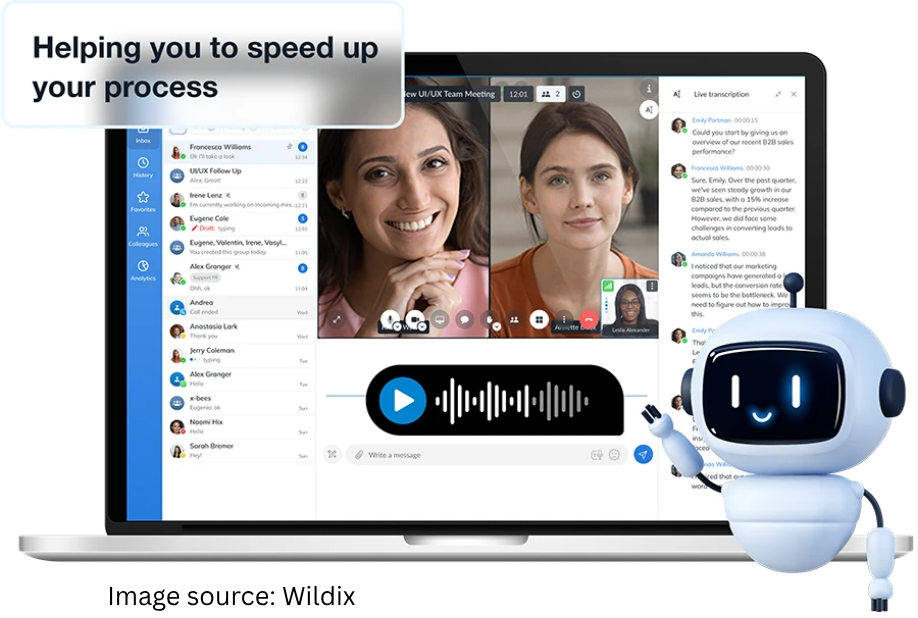
Drum roll, introducing Wildix Collaboration 7: The All-in-One Communication Powerhouse
While iOS 26 is helping rebuild trust in voice calls, Wildix Collaboration 7 is helping businesses deliver those calls, and much more, with clarity, speed, and confidence.
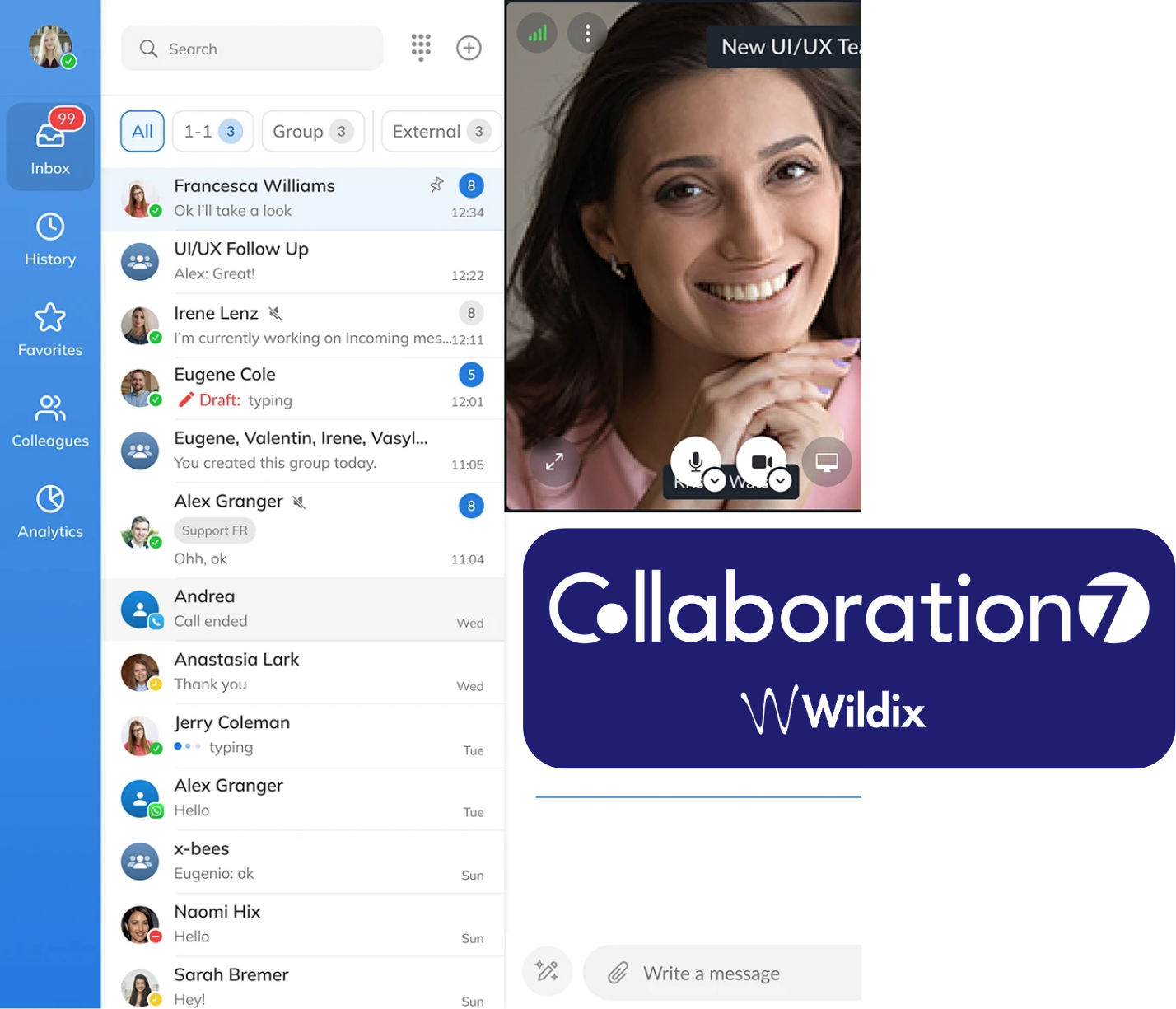
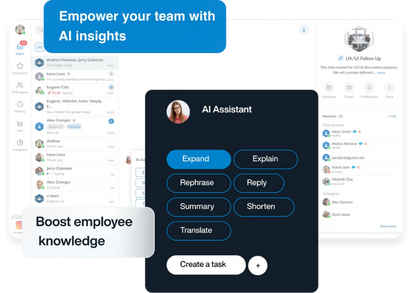
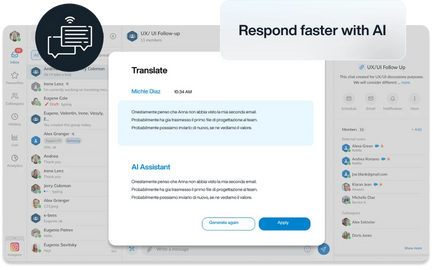
Wildix’s AI-enhanced platform brings together voice, video, chat, SMS, and collaboration tools in one browser-based solution. It’s designed for modern teams who need to stay connected across devices, locations, and time zones, without the hassle of juggling multiple apps.
-
Real-time presence, chat, and video meetings from any device.
-
AI-powered call summaries and transcriptions to save time and improve follow-up.
-
Built-in security and 99.99% uptime backed by AWS infrastructure.
-
Over 250 integrations including CRM and productivity tools.
-
Global reach with local DIDs in 135+ countries.
Whether you’re managing a remote team, supporting customers around the globe, or just trying to make your outbound calls count, Wildix gives you the tools to do it all, securely, efficiently, and with a human touch.

In Summary:
With trust in phone calls at an all-time low, thanks to robocalls, scams, and AI voice fraud, Apple’s upcoming iOS 26 update (launching September 2, 2025) brings much-needed features to help rebuild confidence in picking up the phone. Features like Live Translation, Call Screening, and Hold Assist to the iPhone crowd. While Android users may have seen it all before, Apple’s strong on-device privacy stance is making waves in the communication space.
This matters big time for businesses, especially in sectors that rely on outbound calling. Done right, these new tools can help real businesses stand out from spam and connect more effectively with customers. The key? Relevance, clear intent, and smart tech.
Finally, we introduced Wildix Collaboration 7, a powerful all-in-one platform that blends voice, video, chat, and AI tools into one seamless experience. And here’s the real kicker: when you combine the new iOS call tools with Wildix’s robust communication suite, you get a smarter, faster, and more secure way to keep your team and your customers connected.
Photo credit: Wildix.
Want to know more or book a free demo? Email, call, complete a form, or send a carrier pigeon. We’re here to help.
Get in touch

Is iOS 26 a Friend or Foe to Your Business?
Is iOS 26 a Friend or Foe to Your Business?
iOS 26 updates and the timeline:
Let’s be real, most people dodge unknown calls like junk mail. With scam calls, robocallers, and AI-generated voice fraud flooding our phones, it’s no surprise. The result? Trust in the humble phone call is in the balance. And for legitimate businesses, getting through has never been harder.
Cue iOS 26, Apple’s latest update dropping on September 2, 2025, with some new call features that aim to restore a bit of that lost trust in phone calls. However, it’s hard to ignore the controversy around ‘who did it first’, with articles like Apple borrows plenty from Android with iOS 26 (1) and iOS 26 is basically Android’s greatest hits from five years ago (2).
So let’s set the scene with a timeline:
2018 – Pixel Starts the Party: Google’s Pixel phones were ahead of the curve when they introduced features like Call Screen, Hold For Me, and later on, real-time Live Translate. Android users have been enjoying these tools for years, like having their own personal call assistant on their phone.
2024 – Samsung joined the chat: Fast-forward to January 2024, and Samsung brought similar features to the mainstream with the Galaxy S24 and its Galaxy AI. The highlight? Live Translate during calls in real-time, and yes, it even works offline in multiple languages. Pretty nifty.
2025 – Apple Arrives Fashionably Late: With iOS 26, features like Hold Assist (which… let’s be honest, is very similar to Google’s Hold For Me) are finally landing on iPhones. And suddenly, everyone’s paying attention, because let’s face it, when Apple moves, the world notices.
And it couldn’t come soon enough. According to Cognism, the average cold call success rate in 2025 has dropped to just 2.3%, nearly half in comparison to 2024. But let’s be clear, for those with a cold calling strategy, it isn’t dead, just bad cold calling is. The businesses breaking through today are powered by data, purpose, and relevance.

Apple’s Take on Trusted Tech – Privacy First
Apple may be arriving late to the feature party, but it brings signature polish and an uncompromising privacy stance. Unlike Google’s cloud-assisted versions, Apple processes everything on-device, so your data stays on your phone. For privacy-conscious users, that’s a powerful differentiator.
Here’s what’s landed in iOS 26:
-
Live Translation:Real-time translation built into Phone, Messages, and FaceTime
-
Call Screening: iPhone prompts unknown callers to state their name and reason, then shows a live transcript
-
Hold Assist: Detects hold music, mutes it, and alerts you when a human answers
Feature Breakdown: Call Smarter, Not Louder
-
Call Screening: No More Guesswork, Unknown number? Let your iPhone handle it. iOS 26 politely asks who’s calling and why, transcribes the answer in real time, and lets you decide if it’s worth picking up. Filters out spam and robocalls, and boosts chances for real businesses to be heard.
-
Hold Assist: No More Wasted Time. Your phone waits on hold so you don’t have to. It mutes the music, listens for a live agent, then rings you when someone picks up. It even lets the agent know you’re on your way back. This saves time and sanity by making customer service less painful.
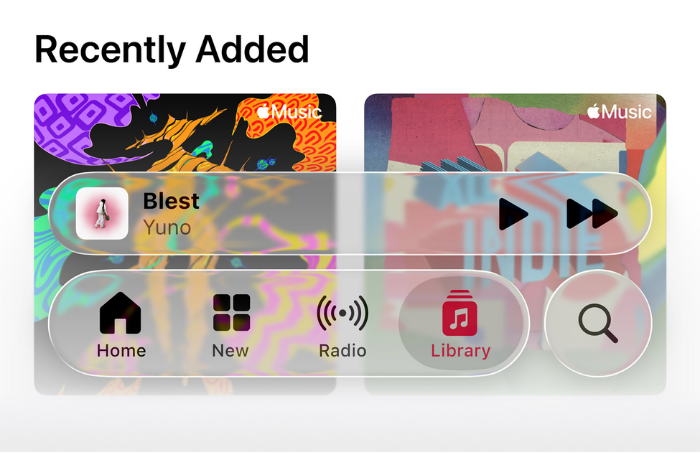



Image credit: Apple Website, July 2025.
Why It Matters for Real Businesses
For sectors that rely on outbound calls like healthcare, finance, and support teams, these features aren’t just nice to have; they’re mission-critical. Instead of being blocked or ignored, your calls can now be screened, recognised, and answered if you get the approach right. Clear identification, a valid reason to call, and relevance are now your ticket in.
The Bottom Line:
iOS 26 doesn’t just block spam, it helps honest businesses be seen, heard, and trusted again. In our next blog post, we’ll discuss how this update, when paired with a platform like Wildix Collaboration 7, becomes part of a smarter, more strategic communication stack that empowers teams and improves customer experience.
Because in 2025, it’s not about calling louder, it’s about calling better.
Source:
- Apple borrows plenty from Android with iOS 2, Android Police, 9th June 2025.
- iOS 26 is basically Android’s greatest hits from five years ago, Android Police, 23rd June 2025.
- Cognism, March 2025, and Cognism, June 2025
- Google just accused iOS 26 of copying these 3 features on iPhones – and it has a point, Tech Radar, 18th June 2025
Image credit: Apple Website, July 2025.
Want to know more and how our team at Evoke Telecom can help with your communications needs? Then get in touch, we’d love to hear from you.
Get in touch

Wildix Takes Triumphant Treble at Channel Champions Awards
Wildix Takes Triumphant Treble at Channel Champions Awards
Channel Championships Awards 2025
We’re buzzing with excitement for our friends and product partners, Wildix, who smashed it at the prestigious Channel Champions Awards held at Regent’s Park on July 3rd, 2025.
The ceremony, hosted by sports presenter and TV personality Mike Bushell, best known for his work on BBC’s flagship morning show BBC Breakfast, celebrated the very best in the channel industry, and Wildix didn’t just win…they cleaned up, walking away with not one, not two, but three major awards!

Wildix welcomes a triple award win…
The Executive Leadership Team at Wildix proudly accepted the ‘Channel Champions Team of the Year’ award, now taking pride of place in their growing awards cabinet. In addition, Wildix also took home ‘Vendor Sales and Account Management Team of the Year’ as well as ‘Vendor/Distributor Executive Leadership Team of the Year’, a true testament to the entire organisation.
As a proud Wildix reseller, we’ve always known that Wildix has a truly outstanding team, one that not only offers a best-in-class product portfolio but also backs it up with an unwavering commitment to support, innovation, and leadership. Their success is a win for everyone in the Wildix partner community, and we couldn’t be more thrilled for them.

-
Channel Champions Team of the Year
-
Vendor Sales and Account Management Team of the Year
-
Vendor/Distributor Executive Leadership Team of the Year
Congratulations again to the whole team at Wildix!
Photo credit: Wildix LinkedIn & Comms Dealer.
If you would like to know more about award-winning Wildix, chat today.
Get in touch

CCaaS Lite
CCaaS Lite: Combining UCaaS and CCaaS for a smarter approach
The Rise of CCaaS Lite
Contact Centre technology has long presented businesses with a stark choice: invest in a fully-featured Contact Centre as a Service (CCaaS) platform, or rely on a more basic Unified Communications as a Service (UCaaS) system.
The Cost Conundrum
For many organisations, these two options present an uncomfortable reality: forced to choose between comprehensive CCaaS solutions, packed with features that many employees may never use, or settling for inadequate customer service tools.
If your team isn’t fully leveraging a CCaaS platform, it can start to feel like an unnecessary expense, especially when CCaaS typically costs 7–10 times more per seat than UCaaS. While CCaaS undoubtedly offers powerful customer engagement capabilities, not every business needs the full suite, nor do all employees require advanced features.
Take, for example, a mid-sized company with 50 employees, where only 10 handle customer interactions. Paying premium CCaaS rates for those 10 users, while the remaining 40 use standard UCaaS, results in a cost structure that is hard to justify.
Fortunately, a more flexible and cost-effective middle ground is emerging – CCaaS Lite. This approach bridges the gap between UCaaS and full-featured CCaaS by allowing companies to selectively add key customer engagement tools to their existing UCaaS solution.
Emergence of CCaaS Lite
Instead of an all-or-nothing investment, more businesses are taking a smarter route, building their own CCaaS Lite solutions by integrating targeted contact centre features into their current UCaaS platforms. This “pick and mix” strategy empowers organisations to create bespoke customer service capabilities without incurring the costs of a full CCaaS deployment.

Popular CCaaS Lite Add-ons Include:
-
Dynamic Reporting: Real-time dashboards and customisable reports provide managers with the insights needed to optimise performance and enhance customer satisfaction.
-
Wallboards and Visibility Tools: Visual displays show queue status, key performance indicators, and metrics, keeping teams aligned and responsive.
-
Enhanced Analytics Suite: Advanced data analysis helps identify trends, measure success, and inform decisions around resource allocation and operational improvements.
-
Secure Compliant Call Recording: Ensure regulatory compliance and maintain quality standards.
-
Multi-Channel Communication: Support for WhatsApp, live chat, and social messaging channels, meeting customers where they are with omnichannel customer engagement
-
AI-Powered Tools: Smart automation, including chatbots, sentiment analysis, and automated responses, boosts efficiency while retaining the human touch that customers value.
Why it works
This smart, tailored approach delivers several key benefits:
-
Cost Efficiency: Pay only for the features your team needs, reducing per-seat costs while getting the functionality that drives results.
-
Scalability: Add features as your business grows or evolves, perfect for adapting to seasonal demand or expanding operations.
-
Faster Implementation: Integrating new features into an existing UCaaS system typically involves less disruption and quicker deployment than full CCaaS rollouts.




The Strategic Sweet Spot:
For many organisations, especially in the mid-market, CCaaS Lite hits the strategic sweet spot. It recognises that not every business requires enterprise-level contact centre capabilities, while also acknowledging that basic UCaaS features may fall short for today’s customer service expectations.
This approach is particularly valuable for businesses navigating growth, shifting service needs, or fluctuating demand. Instead of locking themselves into costly, oversized solutions, companies can build their customer engagement toolkit incrementally and sensibly.
Breaking down the crossover
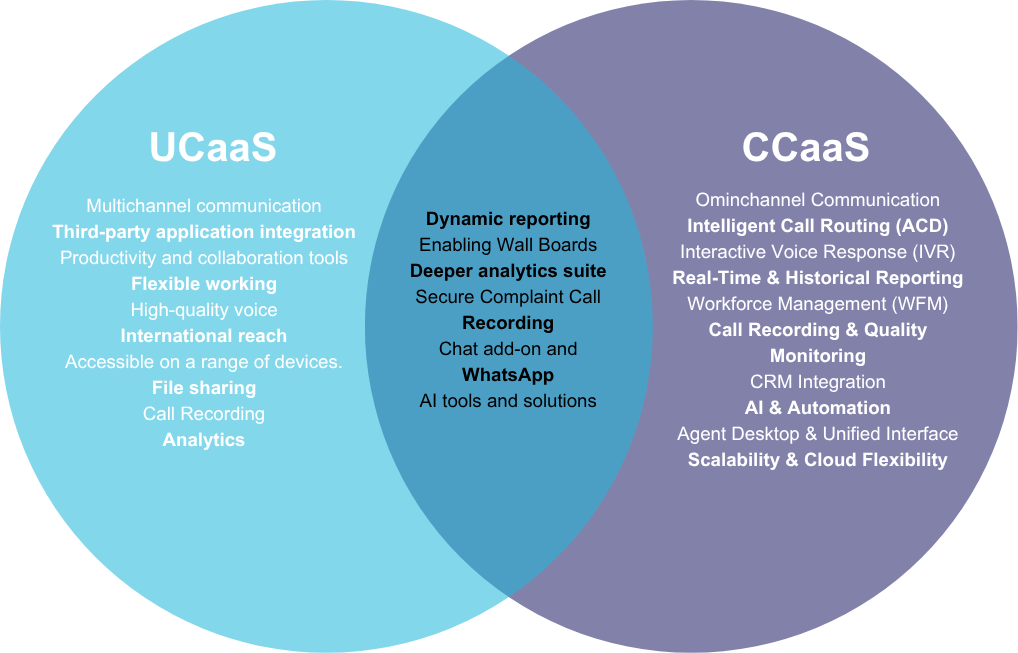
The right choice for you
More businesses are realising that they don’t have to choose between high-end CCaaS and budget-friendly UCaaS. Instead, they’re crafting the right blend of features to match their needs and resources.
If you’re reviewing your customer communication strategy, the real question isn’t “UCaaS or CCaaS?” It’s how to combine the right features to serve your customers effectively without breaking the bank.
We’d love to help, as here at Evoke Telecom, we’ll work with you to design a solution that fits your needs and your budget. After all, the best communication solution isn’t the one with the most features, it’s the one that gets used and delivers measurable results for your business.
Ready to explore what CCaaS Lite could look like for your organisation? Get in touch today, we’d be delighted to show you what’s possible.

Cloud Telephony vs Contact Centre: What’s the difference and why do you need it
Cloud Telephony vs. Contact Centre: What’s the difference and why do you need it
Cloud Telephony vs. Contact Centre
When it comes to staying connected, the cloud has become the go-to unified communication solution, and it’s only getting bigger.
According to Gartner*, global spending on cloud services is set to reach over $723 billion in 2025. More businesses are ditching old-school infrastructure in favour of cloud-first strategies, driven by flexibility, cost reductions, AI integration, and hybrid working trends.
Two popular cloud-based communication tools that often get mixed up are cloud telephony and cloud contact centres (CCaaS). They might sound similar, but they serve very different purposes and understanding the difference can help you choose what’s right for your business.

What is Cloud Telephony?
Cloud telephony is essentially your phone system in the cloud. It allows you to make and receive calls over the internet using VoIP (Voice over IP) without needing traditional phone lines or hardware.
Whether you’re in the office, at home, or on the go, you can handle calls from your laptop, mobile, or IP phone. It often includes handy features like voicemail-to-email, call forwarding, and even video calling or chat if you’re using a Unified Communications (UCaaS) platform.
Great for: Businesses that want a professional, flexible phone system that works from anywhere, without heavy infrastructure.
What is a Cloud Contact Centre?
A cloud contact centre (CCaaS) is built for customer-facing teams. It lets businesses manage conversations across voice, email, chat, SMS, and social media, all from a single platform. It routes customer queries to the right people, integrates with CRMs, and gives team leaders powerful analytics and real-time insights.
You can also track the full customer journey, use AI-powered chatbots, and monitor agent performance in detail, making it a powerful tool for improving customer service levels and satisfaction.
Great for: Sales, support, and customer service teams handling high volumes of multi-channel interactions.


Do you have to choose just one? Not at all!
One of the best things about today’s cloud platforms is flexibility.
Many businesses use UCaaS for most staff, and add CCaaS (Contact Centre as a Service) for teams who need advanced customer engagement tools.
At Evoke Telecom, we work with market-leading providers:
8×8
8×8 delivers a unified, easy-to-use cloud platform that brings together contact centre, voice, video, chat, and Microsoft Teams integration, all enhanced by AI to boost performance and productivity. With flexible licensing, you can choose “Work” licences for everyday users and “Contact” licences for customer-facing roles, so you only pay for the features you actually need.

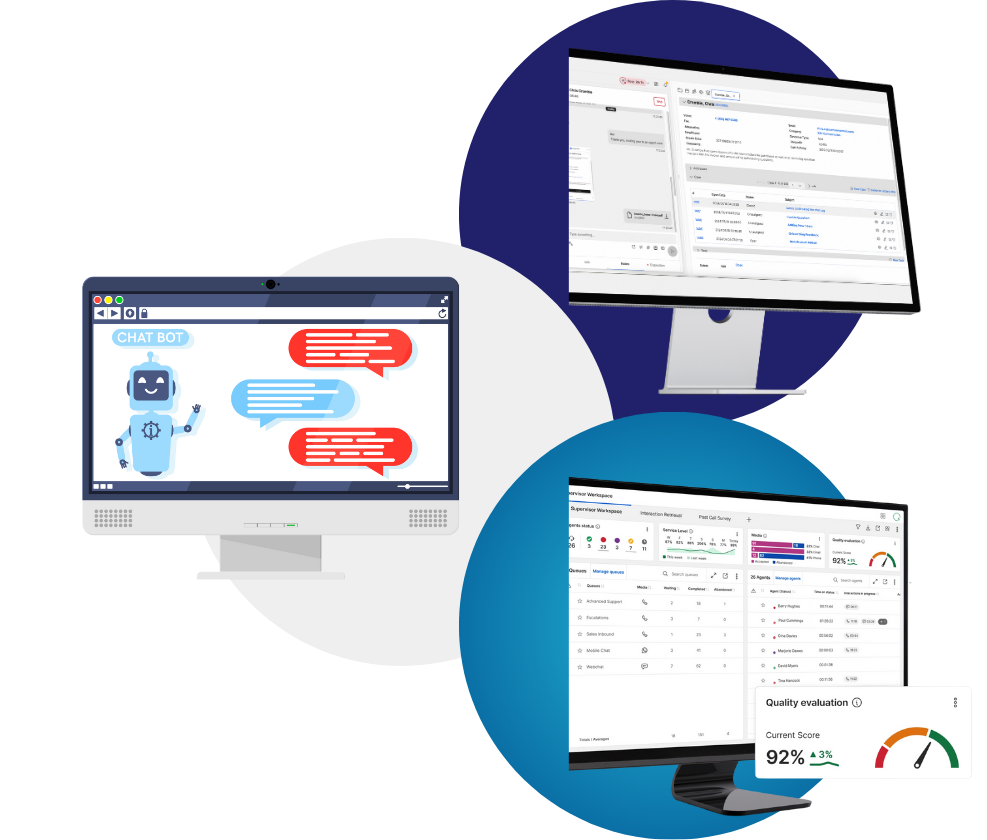
ipSCAPE
ipSCAPE adds powerful contact centre capabilities on top of existing systems like Wildix, without disrupting your current setup. It’s a comprehensive CCaaS solution, offering features like Dialler, Agent Scripting, Call Recording, Quality Assurance, and more — all included under one simple, all-in-one licence.
Using a mixed model approach is ideal when only a portion of your team needs the extra power that CCaaS provides.


How can CCaaS be a game-changer?
CCaaS platforms offer more than just better call handling, it is the foundation for smarter operations and stronger customer experiences. Some of the biggest wins include:
-
Advanced Reporting & Analytics: CCaaS helps elevate both your Management Information (MI), the real-time, day-to-day data used to monitor KPIs, and your Business Intelligence (BI), which uncovers trends and supports long-term strategy. With feature-rich built-in analytics tools, you gain deeper insights, better visibility, and more informed decision-making.
-
Agent Status Tracking: Understand exactly why agents are unavailable, whether they’re on lunch, writing up notes in the CRM, in training, or on a Teams call. This transparency helps with planning, productivity and having a better understanding of how your team uses its time.
-
Wallboards: Real-time dashboards display live metrics like call volumes and handling times, number of missed calls, and all data that gives supervisors and teams the visibility they need to stay on top of performance and to keep making informed decisions on how to improve.
As you can see, it’s not just about picking up the phone faster, it’s about optimising your people, processes, and data to deliver exceptional customer service. The bigger picture.
Which One’s Right for You?
While there’s general guidance on when to choose UCaaS or CCaaS, every business is different. It’s not just about what you need today, it’s also about where you’re headed, how your team will grow, and the kind of customer experience you want to deliver.
The good news? You don’t have to pick just one. Many organisations are blending UCaaS for everyday communication and CCaaS for customer-facing teams, and platforms like 8×8 and ipSCAPE are built to support that flexible approach.
At Evoke Telecom, we’re here to help you find the right mix. Whether you’re looking for simple cloud calling or a feature-rich contact centre solution, we’ll guide you through your options and match you with scalable, best-in-class tools.

*Gartner, Gartner Forecasts Worldwide Public Cloud End-User Spending to Total $723 Billion in 2025 LONDON, U.K., November 19, 2024.

Using the Mobile Networks for Internet Access Failover
Using the Mobile Networks for Internet Access Failover
What is 5G recap…
‘5G, which stands for fifth-generation cellular wireless network, is a cloud-based network that connects people on mobile devices to the internet faster than previous networks. While 4G requires cables and infrastructure to run smoothly in a neighbourhood, 5G’s cellular towers amplify cloud-based signals, which eliminate many cable-related needs.’
Pamela Bump, Hubspot.
Integrating 5G with Fixed and Mobile Routers with Mobile Failover
For the majority of businesses, reliable connectivity is critical for keeping operations running smoothly, delivering excellent customer service, and maintaining high productivity levels. Even brief periods of network downtime can lead to lost revenue, disrupted workflows, and damage to a company’s reputation. That’s why failover solutions have become essential, providing the resilience businesses need to safeguard continuity and performance.
Failover is a backup system designed to seamlessly take over when the primary connection fails. For businesses, this ensures continuity, allowing operations to proceed with minimal disruption even if their main internet connection goes down. Many companies are turning to fixed and mobile routers with mobile failover capabilities. These devices offer the best of both worlds: the stability of a fixed connection and the flexibility of mobile connectivity. If the primary fixed connection fails or underperforms, the router seamlessly switches to a mobile connection, ensuring continuous and reliable internet access.

How does the router work?
-
Wide Area Network (WAN) Connections Failover routers are equipped with dual or multiple WAN ports, allowing them to connect to different internet service providers or network connections for enhanced reliability.
-
Automated Failover: The router continuously monitors the primary connection and, in the event of a failure, automatically switches to the backup. Once the primary connection is restored, in most cases it seamlessly reverts to the original network.
-
One example is the MikroTik Chateau 5G ax, a super-fast Wi-Fi router that uses 5G to provide stronger, more reliable internet, even in areas where traditional broadband might struggle. It supports Wi-Fi 6, meaning it delivers smoother, faster connections for multiple devices at once.
-
With advanced security features and multiple ports for wired connections, it’s great for home users, businesses, and remote workers who need stable, high-speed internet. Whether streaming, gaming, or working online, this router helps keep everything running without lag or interruptions. Want to know more? Get in touch.




Advantages for Businesses
-
Resilience: Mobile failover ensures uninterrupted connectivity without the need for traditional wired infrastructure
-
Speed: 5G’s high speeds can rival or even surpass full fibre in certain scenarios, providing a competitive edge.
-
Scalability and Flexibility: 5G’s scalable nature accommodates growing connectivity demands, while its plug-and-play nature benefits companies with temporary locations, remote offices, or pop-up events.
-
Coverage: Expanding 5G coverage enables businesses to operate effectively even in areas with limited infrastructure. A game changer for businesses
-
Immediate Improvement: Businesses can enjoy faster speeds and lower latency right away.
-
Future-Proofing: As 5G coverage expands, the performance and reliability of these solutions will only improve.
-
Competitive Edge: By adopting 5G early, businesses can enhance their operations, reduce downtime, and provide superior service to their customers.
Which Failover solution is right for you?
-
Connection speed: The backup connection must be fast enough to support critical operations without disruption.
-
Ease of Implementation: Look for solutions that integrate easily with your existing network setup to avoid unnecessary complexity during deployment
-
Number of Devices: If you have many devices, ensure the failover solution can handle the traffic load.
-
Cost effectiveness: While leased lines offer reliability, alternatives like 4G/5G or broadband failover may be more budget-friendly for smaller businesses
-
Provider Trustworthiness: Work with reputable telecom providers who deliver strong Service Level Agreements (SLAs) and proactive network monitoring for greater peace of mind.
Embracing 5G
While 5G holds tremendous potential, it’s important to note that it complements rather than replaces full-fibre networks. Together, these technologies create a resilient, high-performance connectivity ecosystem.
As the full fibre rollout progresses, businesses don’t have to wait in limbo. 5G offers a powerful solution to bridge the gap, ensuring robust and reliable connectivity. By leveraging fixed and mobile routers with mobile failover, companies can navigate today’s connectivity challenges while preparing for tomorrow’s technological advancements.
Embracing 5G is not just about staying connected; it’s about staying ahead. Here at Evoke Telecom, we’re committed to helping businesses navigate these options and implement tailored solutions for their connectivity needs.
Get in touch today by email, telephone, or contact form to start a conversation about how we can help.

What Is 5G and Why Do You Need It?
What Is 5G and Why Do You Need It?
What is 5G?
‘5G, which stands for fifth-generation cellular wireless network, is a cloud-based network that connects people on mobile devices to the internet faster than previous networks. While 4G requires cables and infrastructure to run smoothly in a neighbourhood, 5G’s cellular towers amplify cloud-based signals, which eliminate many cable-related needs.’
Pamela Bump, Hubspot.
Full fibre broadband offers unprecedented speeds and reliability, however, the rollout has been slower than anticipated, especially for businesses in remote areas. This delay in high-speed fibre connections can significantly impact productivity and competitiveness, leaving many companies looking for alternative solutions.
Enter 5G, the next-generation mobile technology that is revolutionising business connectivity. With its ultra-fast speeds and low latency, 5G provides a viable alternative for businesses awaiting the arrival of full fibre. Designed to support a vast number of connected devices, 5G is ideal for modern business environments that rely on IoT devices and smart technologies.

5G UK market snapshot:
In the first half of 2024, a Vodafone report highlighted that in the UK, small and medium-sized enterprises (SMEs) are losing out on up to £8.6 billion annually in productivity savings attributed to the slow rollout of standalone 5G networks. The primary hurdles? Insufficient investment and infrastructure challenges.
A report released by Ofcom, in December 2024 paints a more positive picture. The deployment of 5G networks is gradually increasing. Mobile 5G availability continues to expand, now handling over a fifth (21%) of all monthly mobile data traffic in the UK. Around half of all mobile handsets are now 5G capable.
And there’s more good news. The merger between Vodafone and Three UK, announced in December 2024, is set to accelerate the rollout of 5G. Their vision is to build one of Europe’s leading 5G networks, bringing faster speeds and better coverage to every corner of the country with significant investments in best-in-class 5G infrastructure.




Built for Better: People, Tech, and Service Excellence
5G is more than just an advancement in mobile technology—it’s an essential asset for businesses looking to remain competitive.. Although challenges related to infrastructure and investment have slowed deployment, progress continues, with increasing network availability and growing handset adoption.
The merger of Vodafone and Three UK is set to accelerate the expansion of a nationwide 5G network, delivering faster speeds, enhanced reliability, and new possibilities for innovation that benefit both businesses and consumers.
For companies awaiting full fibre or aiming to future-proof their operations, 5G presents a powerful and adaptable solution. As coverage expands, integrating 5G could be the key to unlocking higher productivity, improved efficiency, and long-term growth.
Coming up…
There is so much more to the 5G story, so in our next blog post, we’ll explore using mobile networks for internet access failover.
If you have any questions about how we can get you started on your 5G journey, just get in touch.
Get in touch

Unlocking Efficiency: The Power of Business Mobile Applications
Unlocking Efficiency: The Power of Business Mobile Applications
The Power of Business Mobile Applications
In the business world, the telecommunications industry is pivotal to customer service and support, offering everything from contact centres and AI-powered tools to cloud-based unified communication platforms. Here we dive into the realm of telecommunication mobile applications for smartphones.
Smartphones enable convenient, on-the-go use of company-specific software and third-party apps, along with access to emails, calls, messages, and more. These handy pocket computers also improve employee collaboration (1).
Organisations are constantly seeking to digitally reinvent themselves and advance their digital transformation journey. Amid current economic uncertainty and ongoing inflation, the focus is on achieving sustainable business growth while doing “more for less” all without increasing budgets. Companies aim to minimise trial and error in their strategies and expect clear ROI and business value from their investments. This brings us to the benefits of mobile work apps (2).
Mobile devices support several communication channels: Live website chat, email marketing, text messaging, voice calls, social media, and more. These forms of communication empower businesses to stay relevant and maintain open lines of communication with customers, clients, and colleagues, ultimately reducing inbound call volumes.
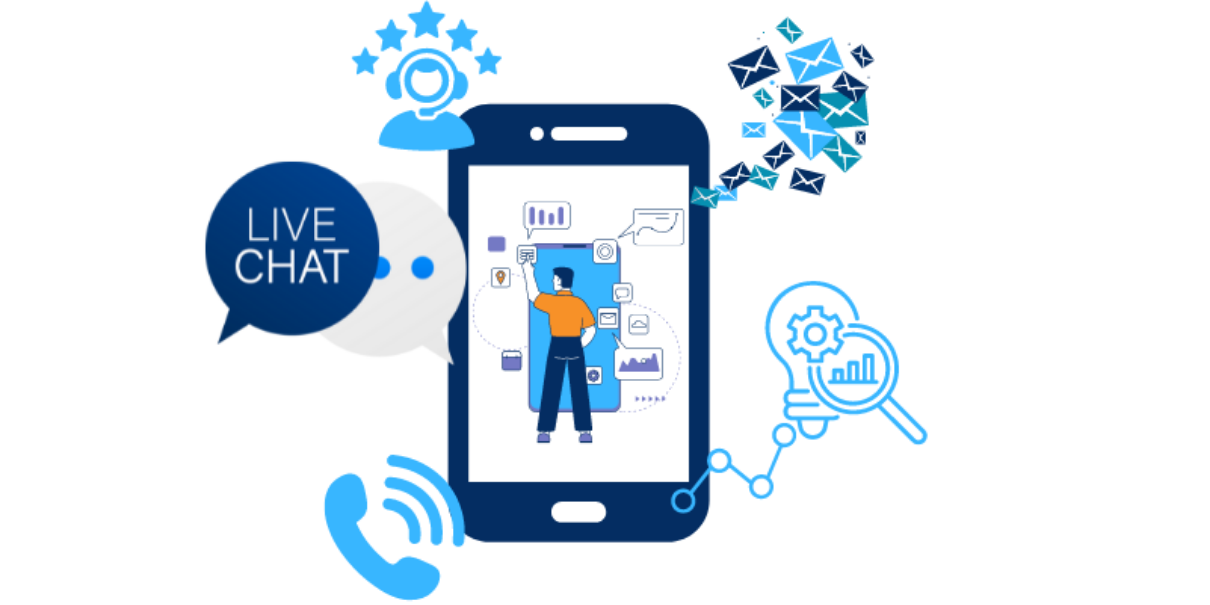
Market trends in the mobile business application space at Evoke Telecom 2025:
Market trends in the mobile business application space at Evoke Telecom 2025:
- A mobile business app being part of our solutions emerged as a major trend for us throughout 2024 and continues into 2025, often being a prerequisite for customers
- We’ve seen growing demand for solutions that enhance business efficiency, support remote work, and integrate AI into business strategies.
- The need for seamless contact on the go, not just via voice but also through chat (including group conversations).
- Visibility of colleagues’ statuses and availability in real-time
Our strategic partnerships with iPECS Cloud, Wildix, 8×8 Work, and Gamma Horizon include a mobile application offer, which not only ticks the boxes above but also offers:
- Significant savings on international calls by using zero-cost Wi-Fi to connect back to your UK company’s phone system.
- Centralised company information and updates simplify compliance efforts.
- Integration with CRM and back-office systems eliminates countless hours of unnecessary admin.
Now let’s explore the different points of view from a business owner’s to an employee’s perspective.

A business owners perspective:
Cost Savings: Mobile apps enhance employee efficiency, flexibility, and overall job satisfaction. What is more because the work over data – eg Mobile and WiFi they can save a fortune in calling costs whilst overseas
Reduced Hardware Costs: Smartphone apps can reduce the need for additional hardware like desk phones and computers, saving money.
Scalability: Easily scale your business.
Easier Training and Onboarding: Mobile apps are often more intuitive, making training and onboarding faster and more efficient.
Secure Access: Many apps come with built-in security features like encryption and multi-factor authentication, ensuring secure access to sensitive data.
Remote Management: IT departments can manage and secure mobile devices remotely, ensuring compliance with company policies and data protection regulations.

An employees perspective:
Anytime, Anywhere Access: Employees can handle calls, emails, and chats from their smartphones, managing customer interactions even when away from their desks.
Quick Access to Information: Apps enable employees to quickly access customer information, history, and support resources, leading to faster issue resolution.
Increased Productivity with Multi-Tasking: Employees can switch between different tasks and apps on their smartphones, improving their ability to manage multiple customer interactions simultaneously.
Improved Customer Service: With customer data and conversation history at their fingertips, employees can provide a more personalised experience, enhancing overall customer satisfaction.
Fewer Distractions: Mobile apps are faster for users and can include useful features like push notifications (3).
Real-Time Collaboration: Mobile apps often include features for real-time communication and collaboration, such as instant messaging and video calls, fostering better teamwork.
Notifications and Alerts: Employees can receive instant notifications for important updates and customer interactions, ensuring they stay informed and responsive.
Improved User Experience: Mobile apps provide a more streamlined and user-friendly experience compared to mobile websites.
Efficiency Boost: Mobile technology enables contact centre employees to work remotely, reducing infrastructure costs and boosting morale. Integrating call centre apps with chatbots automates repetitive tasks, saving time and increasing overall efficiency.
The emergence of live video chat
As we explored the power of mobile applications in telecommunications, the emergence of live video chat stood out as one of the next big things. Many companies are increasingly enabling ‘live video chat’ options for customer service. Companies like Apple, Hertz, and Nordstrom have already adopted this approach, offering several advantages:
Enhanced Personalisation: Video chat allows for face-to-face interaction, making customer service more personal and engaging.
Improved Issue Resolution: Visual communication can help resolve issues more quickly and accurately, as agents can see exactly what the customer is experiencing.
Increased Customer Satisfaction: Customers often appreciate the immediacy and clarity that video chat provides, leading to higher satisfaction levels.
Competitive Advantage: Offering advanced customer service options like live video chat can set a company apart from competitors.
Building Trust: Seeing a real person can help build trust and rapport with customers, fostering stronger relationships.
In conclusion
While larger companies are adopting this technology, we predict it will soon become a standard feature across the industry and one that we will be looking out for!
In the ever-evolving business landscape, telecommunications and mobile applications have become indispensable tools for enhancing efficiency, flexibility, and customer satisfaction. Smartphones and mobile apps enable companies to streamline operations, reduce costs, and provide robust, multi-channel customer service. At Evoke Telecom, we’ve seen firsthand the transformative power of these technologies through our partnerships with iPECS Cloud, Wildix, 8×8 Work, and Gamma Horizon.
For business owners, mobile apps offer significant cost savings, reduced hardware expenses, and easier training and onboarding. They also ensure secure access to sensitive data and facilitate remote management. For employees, these apps provide anytime, anywhere access to crucial information, boosting productivity and improving customer service through real-time collaboration and fewer distractions.
In conclusion, embracing mobile applications in telecommunications is not just about keeping up with trends—it’s about staying ahead in a competitive market, driving sustainable growth, and delivering exceptional value to customers.
Over the coming weeks, watch out for a mini-blog series that will explore the mobile application offerings from our partnership portfolio.

What is the link between an AI Action Figure and your Business Performance?
What is the link between an AI Action Figure and your Business Performance?
AI action figure and your business
Creating an AI-generated action figure—whether of yourself, a celebrity, or even a pet—has quickly become a global phenomenon. But what sparked the viral craze? OpenAI’s launch of its ChatGPT image creator, powered by GPT-40, led to a surge of users eager to try the feature and share their results on social media (1).
So, naturally, we decided to test it ourselves— so one of our Directors, David Wardell, promptly stepped up to the challenge.


How it works…
-
Log in to ChatGPT
-
Upload a photo
-
Add a text prompt describing your ideal action figure
-
Wait for the AI magic to generate a toy image, boxed up and ready for display
In going through this process, we noticed quite a few things, very pertinent to telecommunications and AI that we thought we might share.
So what did we notice?
-
Although the task was Action Figures, anyone could use it, tall or small, yellow or green. It was a simple model that was configurable.
-
It was generative. The first model took the information we gave it. Then we had to refine or add to that information to get step by step closer to the result we were looking for.
-
The AI tool saved the information we had already shared and simply added the new information to generatively improve on its previous output.
-
The end result was impressive, but with more learning and inputs would continuously get much better.

The link
So, what is the relevance of this story on a Telecommunications company website, we hear you ask?
Well, this very same generative AI model is doing the same in the telecommunications space, and is available NOW.
We have our own ‘Action Figure’ AI, delivering power business intelligence, powerful insight, powerful management information – simply using our customers existing telephony – right now. And like the ChatGPT model, it is not restricted to certain sectors, it uses a generic model that enables it to be tailored to any sector, any scenario.
“Sorry, am I lost here? How have we jumped from ‘Action Man & Barbie’ to AI for my business? “ We hear you ask.
Well, in simple terms, today we could:-
- Take your call recordings in a stereo format
- Move them across to an AI tool that we have
- Analyse those calls for a variety of information sources. e.g.
- Sales Effectiveness
- Customer Satisfaction
- Retention Effectiveness
- Compliance Support
- NPS Score
- Word and phrase searching
- Even ‘Sentiment Analysis’
This is available now. It is not quite yet ‘Agentic AI’ in that in the early days, human intervention refines the parameters and enables your modelling to quickly build to meet your requirements. But as the model learns and as the data and intelligence build, the benefits exponentially increase.
Here is one of our products, for example, CX/EX.
But is UK 2025 ready for this technology?
Like the ‘Action Figure’, are we producing these but do not really know what to do with them?
The real challenge lies in using your new AI insights from your calls to improve your business.
- To run compliance checks on all of your calls, not just a handful of them
- To check your calls for keywords, key phrases, ‘no-no’s’, profanity, etc
- To enable your sales leaders to identify winners & losers – and improve your team’s results accordingly
- To identify trends to make your business more cost efficient and more successful in terms of results.
What this viral ‘Action Figure’ craze has done is show us the power of AI and just how easy it is to use.
Action Figures today – Massive increase in business performance tomorrow – AI is here, it is powerful, and in the right hands it can drive not only your top line, but also your bottom line.
So the choice is yours. Go make an ‘Action Figure’, go and increase your business’s performance, or just carry on as things are whilst others steal the march?
If you would like to know more about our AI solutions, we’re here to answer any questions.
Get in touch

What’s in a Price?
What’s in a Price?
What’s in a Price?
Everywhere we look we see prices going up. It has become an accepted part of everyday life. Indeed, it’s hard to find a product or service where prices aren’t going up.
We recently received a message from the Managing Director of one of our customers, quite simply saying,
“We get contacted several times every week by companies telling us they can save us money on our communications services. We would be foolish not to see what they can offer and at what price”.
Of course, he will be able to get cheaper quotes. He will most likely even get cheaper prices on exactly the same solution that we currently provide. But, will he get the same knowledge, trained engineers, wrap around support and service….. Because after all ‘What IS in a price’?
Naturally, he’ll be able to find cheaper quotes—even for the exact same solution we currently provide. We fully expect that. But it’s not just about the cost of the product; it’s about the whole package that Evoke Telecom provide, the added value, ongoing investment in the solution, and the highest level of customer service that comes with it.
This did, however, get us thinking, “What’s in a price”? What is it about that self same product that means our customers should buy it from us?
Key features of our pricing:
When you buy a product or service from Evoke Telecom, more often than not, it will cost more. This is because we work hard to ensure that we not only offer more but also invest to ensure we maintain that exceptionally high bar that we set for ourselves. These ‘reach for the stars’ standards are made up of:-
-
Best in class portfolio
-
Highly trained engineers and staff
-
Retail support hours
-
Investment into our CRM, ticketing system and billing platform
-
Artificial Intelligence products
-
New user friendly website and more




What we offer:
Ensuring all engineers and staff are continuously trained, certified where needed, and supported in their daily needs. Indeed, the employment longevity of our support teams is little short of remarkable.
Systems and tools that ensure our customers can access support immediately and easily.
We look after our staff doing our best to ensuring they have everything they need to do their very best and enjoy what they are doing, with flexible working in terms of hours, location, working days as needed – and the best tools and business solutions to do the job and look after our customers.
In 2024 we added ‘Retail Support Hours’ to our support service offering, for those customers who needed more than the standard 9 to 5 offering, but did not need the full 24/7/365 option.
Following the investment in our new CRM platform, we extended this to our service and ticketing system too, and then put it on our website as an online service portal for our customers. We even added a webchat service too.
We invested in our billing platform to the latest cloud version of our existing service, meaning an uplift in the accuracy of invoicing and greater flexibility in the reports that we send out each month with those invoices.
We also added accountancy access via embedded hyperlinks in our statements so clients can easily download invoice copies, if needed.
We added two new AI providers to our portfolio of products. But rather than these being pre-built into.
And in Q1 2025 we once again invested in our website, delivering access to more product information, more data sheets, and links to training video’s and helpful services.
We continue to invest
So at a time when prices are going up, pressures on the cost of delivering our business is going up – we are investing in services to help our customers and to help our teams.
So when asked “What’s in a price” – we know exactly what is in our price and so do our customers.
Oh yes, and that Managing Director did do an external price check, and yes he did find a cheaper price.
“…Although we have been offered slightly preferential prices from another company who were recommended to us (£xxx per month vs your price before the increase), we are going to stick with you guys for the long run”.
But, guess what, he stayed with us! And not just with us for now, BUT for the long run!
If you would like to know more about what we offer and what’s included in the price, chat today.
Get in touch

Unravelling the Business Headset Minefield
With remote working and a massive move ‘to the cloud’ for business telephony, the business headset market has boomed. Market trends indicate a growing preference for wireless and Bluetooth-enabled business headsets, along with the integration of AI and voice recognition technology. The business headset market is projected to grow at a CAGR of 9.3% from 2024 to 2031 (1). It could be argued that handsets are just so ‘yesterday’ as companies look for flexibility, convenience, and savings, which headsets now deliver.

With advancements in sound quality, noise cancellation, and wireless connectivity, investing in high-quality headsets has become essential for the modern hybrid work environment, whether in-office or remote.
When buying business headsets there are so many factors to consider before investing. You go cheap from the likes of Amazon, you may end up buying again, you buy quality headsets and there is a larger initial outlay, so the question is, is paying more worth it?
For a business owner looking to purchase the best headsets for a large or small business, buying cheap headsets might seem cost-effective at first but it can lead to problems that outweigh the initial savings further down the line.
One of the primary issues is that these headsets often come from unreliable or less reputable sources, which means they might be equipped with outdated software or firmware. This can lead to compatibility issues with modern devices, poor audio quality, frequent disconnections, or other technical glitches that disrupt your workflow. Entry-level headsets are typically manufactured by lesser-known brands, so may find it difficult to contact customer support if issues arise. In many cases, the companies behind these headsets either lack the resources to offer comprehensive support or simply do not prioritise it. Additionally, cheap headsets often don’t receive regular software updates, which are essential for maintaining compatibility with evolving technology and ensuring that any bugs or security vulnerabilities are patched.

To help you make a decision, we have created a checklist of points to consider…
1. Comfort and Ergonomics
- Adjustable Headbands: Choose a model where the headband can be adjusted for different head sizes.
- Cushioning: Opt for well-padded ear cups and headbands for all-day wear.
- Weight: Consider lightweight models for enhanced comfort.
2. Sound Quality
- Microphone: Look for noise-cancelling microphones that provide clear audio transmission.
- Speaker Quality: Ensure the headset delivers a crisp and clear sound.
3. Noise Cancellation
- Active Noise Cancellation (ANC): For noisy environments ANC can help reduce background noise.
- Passive Noise Cancellation: Well-padded ear cups can help block out external sounds.
4. Connectivity
- Wired vs. Wireless: Decide if you need the flexibility of wireless or the reliability of wired connections.
- Bluetooth: Check if Bluetooth connectivity is required for compatibility with multiple devices.
- USB: Consider USB headsets for easy plug-and-play functionality.
- Compatibility: Ensure compatibility with existing devices (PCs, Macs, smartphones).
5. Durability and Build Quality
- Materials: Choose a headset made from durable materials that can withstand daily use.
- Warranty: Check for a good warranty period to protect against defects. Here at Evoke Telecom we offer a 12-month warranty on most headsets and even 2 years on some of our recommended brands.
6. Microphone Features
- Boom Arm: A flexible boom arm can help position the microphone in the ideal spot.
- Mute Functionality: A quick mute function can be useful during calls.
7. Controls and Features
- Controls: For adjusting volume and muting without touching the computer.
- Multi-Device Pairing: Useful if employees switch between different devices.
- Voice Assistants: Integration with voice assistants like Siri or Google Assistant.
8. Battery Life (for Wireless Headsets)
- Talk Time: Ensure the battery life meets the daily usage requirements.
- Charging Time: Consider how long it takes to fully charge the headset.
9. Ease of Use
- Setup Process: Choose headsets that are easy to set up and use.
- User Manual: Use a supplier that offers clear instructions for setup and troubleshooting.
10. Cost and budget:
- Price Range: Determine your budget per headset.
11. Brand and Reviews
- Reputation: Choose reputable brands known for quality.
- User Reviews: Check reviews and ratings from other users for insights into the performance and reliability of both the headset brand and the provider.
“Evoke regularly reviews its solutions’ portfolio to ensure that customers access the best quality and value.” – James Clarke, CEO of JPL Telecom
12. Additional Considerations
- Compliance: Ensure headsets comply with any relevant health and safety regulations.
- After-Sales Support: Be aware of the availability of customer support and the process for troubleshooting and replacements. If you have worked with Evoke Telecom before, you’ll know that we pride ourselves on our customer service, so no need to worry about this one!
13. On-the-go employees
- Protection: For employees who need to transport the headset from office to home, can they do this without damaging the headset?
14. Timescale
- How quickly do you need delivery of your order?

Here at Evoke Telecom we offer the full works from corded, cordless, computer, and USB headsets, to call centre headsets. We have a range of top-tier and entry-level options available to our customers. We are able to provide brands that span across the industry but our most popular ranges come from the big 3, for example:-
We work with the big 3 and our most popular options:
- Jabra
- Poly
- Sennheiser/EPOS
We also offer good value mid-range brands such as:-
- Agent
- JPL
Read more about our headset range here.
As you go about your headset research, you may stumble across UC vs MS (Microsoft Teams) headsets, so let us save you some time with this summary of their differences.
An MS headset is compatible with most video conferencing platforms, so essentially it is a UC headset however MS-certified headsets come with extra pre-installed features. Whilst they offer compatibility with the likes of Zoom or Skype, when it comes to Microsoft Teams, the biggest difference is typically a button on the headset or charging pod. What does magical this button do? Well, when pressed it automatically launches the MS Teams application and in the scenario that you are using your headset for a mobile call, your Teams presence will switch to unavailable.
As with all our product offerings, we trial them thoroughly before adding them to our growing portfolio and we are currently trialling Shokz headsets. This bone-conducting innovative technology transmits sound through the bones of the skull, bypassing the eardrums and delivering audio directly to the inner ear. The jury is still out, but we’ll be releasing a blog post soon to give our verdict.
We know that choosing the right headset can be a big decision, so please don’t hesitate to seek our advice if this is an area where you might need some helpful guidance and tips. So whatever you are looking for, we can help, contact our lovely team today at hello@evoketelecom.com or 01509 278278.

How Artificial Intelligence is Reshaping the Telecom Industry
Today, the UK Artificial Intelligence (AI) market is worth more than £16.8 billion1 and shows no signs of slowing down anytime soon. Keeping up with the ever-changing world of AI is certainly a challenge, so we wanted to take you on a deep dive into how AI is making a big splash and transforming everything from network maintenance to customer service in the world of telecommunications.
To grasp just how important AI is in today’s world, let’s start with some fun facts about AI’s growth and adoption in the UK from Forbes:
- The UK AI market is already worth nearly £17 billion, according to the US International Trade Administration, and is expected to grow to over £800 billion by 2035.¹
- The number of UK AI companies has increased by over 600% over the last 10 years.²
- Around one in six UK organisations, totalling 432,000, have embraced at least one AI technology – according to government research.³
- 68% of large companies, 33% of medium-sized companies, and 15% of small companies have incorporated at least one AI technology.³
Now let’s explore the AI landscape…
Unlocking Valuable Insights
AI is like having a crystal ball for data. It’s constantly analysing huge amounts of customer data to provide insights into behaviours and preferences, helping telecoms tailor their services to what customers really want and need.
As a really simple but practical example, AI can transcribe your calls from their call recording file. It can then take this transcription and cut it down to a simple ‘synopsis’ of that call, which can easily be stored in your customer file or on your CRM. It can then apply some clever algorithms and generate a sentiment analysis for that call. It happens instantly and seamlessly in the background and is available for your teams to access and assess at any time.

Keeping Networks Running Smoothly
AI is a clever thing, with its AI-driven network optimisation. With predictive maintenance, AI’s algorithms can analyse vast amounts of data from network equipment to predict failures and anticipate maintenance needs, reducing downtime and improving reliability. With its traffic management capabilities, AI helps to manage network traffic efficiently by predicting peak times and optimising resource allocation to prevent congestion.
Customer Service Gets a Boost
In today’s fast-paced world, nobody likes being put on hold when seeking customer service. So just how crucial is high-quality customer service?
- In 2024, 88% of customers think customer service is more important than ever.³
- In 2024, 64% of customers said no matter how much they enjoy the product, if the company doesn’t provide good customer service, they will find another company to do business with.³

Thanks to friendly AI-powered chatbots and virtual assistants, your customers can get help 24/7 without any wait time. These bots can handle countless enquiries and troubleshoot issues, leaving your customer service agents to tackle more complex queries. And it doesn’t stop there – with Natural Language Processing (NLP) algorithms, AI dives into your data to offer personalised recommendations, making your customers’ experience feel tailor-made.
Fighting Fraud and Upping Security
Security is a big deal, and unfortunately, no one is exempt, even the big players get targeted. AT&T experienced a data breach⁴ earlier this year alongside T-Mobile in January and May 2024⁵. The good news is that AI is on the good side, the winners’ team. It’s like having a watchdog that never sleeps, constantly scanning for unusual activities that could mean fraud. By spotting these red flags in real time, AI helps keep your data safe. It works to identify potential security threats before they become a problem, helping your network, business, and customers stay secure.
Cutting Costs and Boosting Revenue
AI isn’t just about tech – it’s also great for business. By automating processes and optimising operations, AI can significantly reduce your costs, making everything more efficient.
Driving Innovation
The future of telecom is incredibly exciting with AI in the mix. AI is transforming the industry by boosting efficiency, enhancing customer service, securing networks, and driving innovation. It’s helping telecom companies stay competitive in a fast-paced market. With AI projected to grow to £801.6 billion by 2035, it’s clear that AI is here to stay—and we’re fully onboard. Are you interested in how AI can benefit your business? We’d be happy to help, simply contact us today!
Sources:
- UK Artificial Intelligence (AI) Statistics And Trends In 2024. May 2024, Forbes.
- AI and the future of telecoms, April 2024, Business Reporter.
- Bad Customer Service Could Cost More Than $3.7 Trillion, March 2024, Forbes.
- AT&T data breach: Millions of customers caught up in major dark web leak, March 2024, BBC.
- High Profile Company Breaches, March 2024, Electric.

Are SIM-free smartphones a good option?
Let’s start at the beginning, what is a SIM-free smartphone? Essentially it’s a ‘hardware only’ option where you purchase an unlocked mobile handset without any network or fixed contract attached.
With traditional contracts, while they might offer you a shiny new phone upfront, you’re essentially taking out a loan to cover the cost. This means you’re committed to staying with that network until the contract ends, which can be frustrating if your needs change or you want to switch networks.
With a SIM-free smartphone, you buy the phone outright, meaning it’s yours from day one. No loans, no hidden costs, just pure mobile freedom. It comes with no strings attached, you aren’t tied down to a specific network for years on end, and you have the flexibility to switch networks or plans whenever you want, giving you total control over your mobile experience.

At Evoke Telecom, we have SIM-free handset options from all the big names, including the latest iPhone model and they’re unlocked and contract-free. Plus, if you need something more rugged, we’ve got you covered there too.
The beauty of going SIM-free is once you’ve picked the smartphone(s) that best fits your business needs, you have the freedom and flexibility to pick whichever network suits you best, so you can select a network based on the best coverage in your area or just personal preference.
At Evoke Telecom you can pair your SIM-free handset with a SIM-only deal for your data, minutes, and texts, and voila—watch those monthly bills shrink without getting tied down to a long-term contract.
And did you know? Lots of companies are jumping on this trend. Instead of those big hardware refreshes with hefty upfront costs and long-term contracts, they’re opting for a more flexible and affordable approach. It’s all about replacing hardware when needed, saving money, and being more environmentally friendly.
Here are some handy key benefits:

- Unlocked and contract-free: Enjoy ultimate freedom to choose your network with our handsets, which come unlocked and without any contracts attached.
- All operating systems supported: Whether you’re team iOS or Android we’ve got you covered with our great range of devices.
- Dual SIM Capability: Some of our SIM-free phone ranges support dual SIM functionality, allowing you to have two phone numbers (personal and business) on the same device – for those who wish to keep business and pleasure apart.
- Great choice of handsets: Take your pick from a wide selection of models from all major manufacturers, including the latest iPhone, with Android options starting from as little as £99.00.
- Specialist ruggedised handsets: Including the ever-popular CAT range from Caterpillar.
- Free audit: Reach out to us today for a complimentary audit of your current mobile setup. We’ll help you identify cost savings and provide tailored recommendations for your business.
What’s more, we can also offer a free audit of your current mobile setup to help you figure out the best strategy for your business and where you can pocket some savings.

So why wait? Contact us today so we can help you embrace the freedom of SIM-free! All you need to do is smile and dial our helpful team on our free sales lines 08008403688 – or if you prefer let your fingers do the walking and email us at hello@evoketelecom.com – so what are you waiting for, freedom and savings await.