
The Hidden Compliance Risk: Why Your Business Needs Mobile Call Recording

Why Call Recording Matters

If you’ve ever finished a customer call and thought “I wish I’d written that down” or found yourself in a dispute with no clear record of what was said, you already understand the value of call recording.

But here’s the blind spot some businesses don’t see coming: mobile calls.

Protection: A clear, indisputable record of a conversation resolves disputes quickly and gives customers confidence their calls are being handled professionally.


Compliance: For many organisations, it’s no longer optional. FCA (Financial Conduct Authority)-regulated businesses, those handling PCI DSS (Payment Card Industry Data Security Standard) card payments, and industries with strict audit requirements all need calls recorded, stored securely, and retained appropriately.

The question isn’t “do we need it?” — it’s “are we doing it properly?”


Training: Your best people are doing something right on every call. Recording lets you capture it, share it, and coach from real examples rather than scripted scenarios.


Business Intelligence: Combined with voice analytics tools like CX/EX, recordings become a genuine source of business intelligence — highlighting recurring customer pain points, sentiment trends, and knowledge gaps.
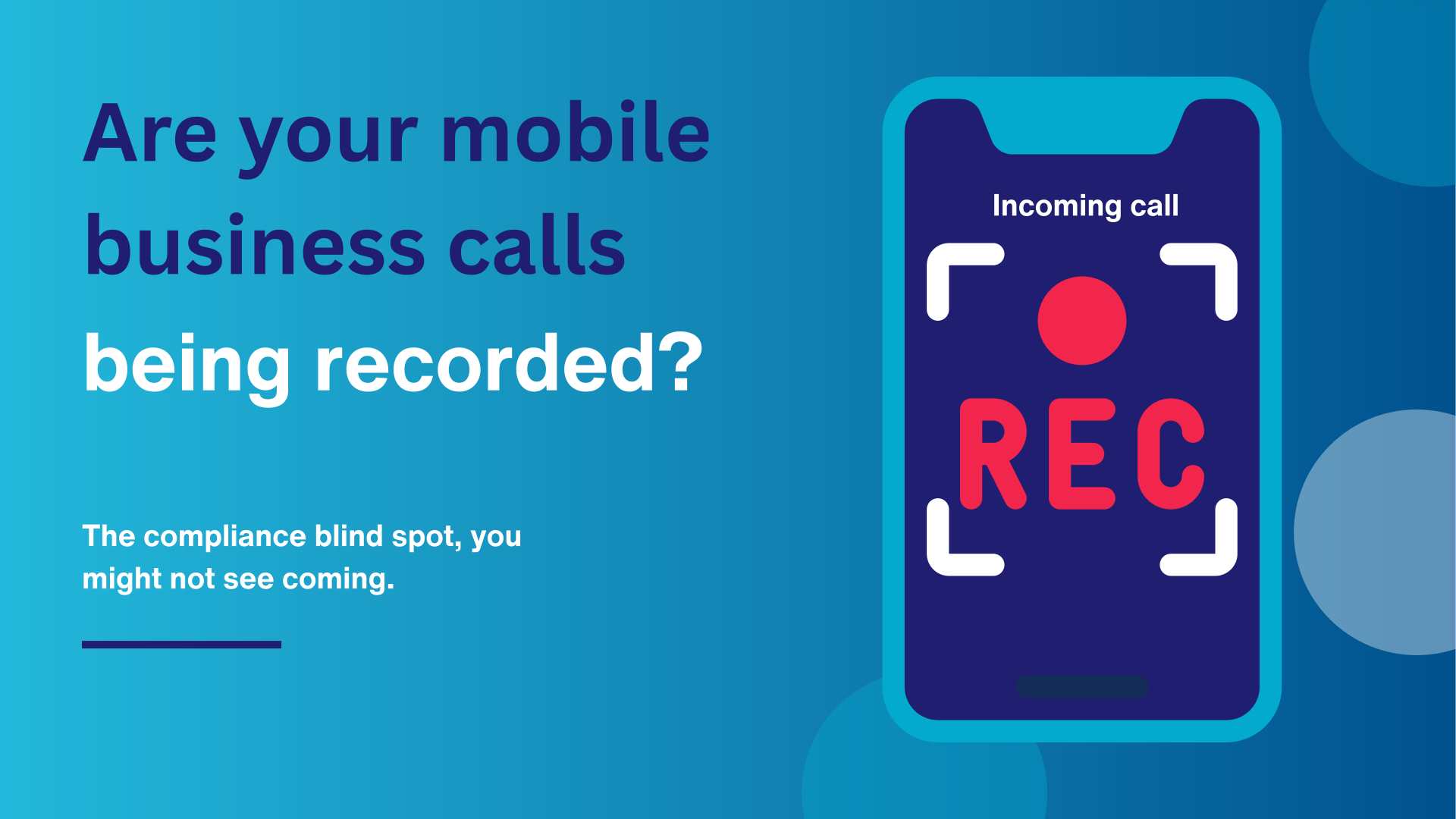


A blue promotional graphic with the text "Are your mobile business calls being recorded?" It includes the subtext, "The compliant blind spot, you might not see coming." To the right is a stylized illustration of a smartphone screen displaying an "Incoming call" notification with a large red "REC" recording symbol inside a viewfinder frame.

The Mobile Recording Gap

Your desk phones may be covered — but what about your sales team, remote staff, or field-based employees making business calls on their mobiles?

It’s a question worth asking because standard mobile calls travel over the cellular network rather than your business platform. This means they sit outside your normal recording environment. It’s not a flaw in the technology; it’s simply how the networks were built.

For regulated businesses in particular, this is a major blind spot—calls made outside of a managed platform simply aren’t being captured. The good news is that there is a straightforward way to bring these conversations back into your secure, recorded environment.

The Solution: VoIP and eSIM-Based Calling

The fix is cleaner than most people expect. By shifting business calls away from the traditional cellular network and onto a UCaaS or VoIP platform, you bridge the gap. Whether you use a dedicated business app or an eSIM setup, the call now travels over the internet.

Because the call is routed through your business platform, it can be recorded centrally, just like a desk phone. The recording doesn’t live on the handset; it is captured and stored securely in the cloud, ensuring total visibility for the business while giving your team the flexibility they need.

How It Works in Practice: Wildix and RAMP

If your team uses the Wildix Collaboration app on iOS or Android, calls are recorded at platform level — not on the phone itself. Recording can be automatic across all calls, or ad-hoc when needed. Everything is saved into the Wildix Collaboration portal with built-in PCI DSS and GDPR compliance, including automatic pause during payment input.

For longer-term retention, RAMP integrates directly with Wildix to transfer recordings into secure AWS S3 storage, with a dedicated interface to search, play back, and download based on user permissions.

The key takeaway: if your team uses the Wildix mobile app, those calls can be recorded, archived, and managed through RAMP. The result is a secure, compliant, and fully manageable mobile recording environment.

What’s the difference between standard vs Wildix?

Business professional utilizing mobile cloud telephony features at an office desk next to an open laptop, representing business call handling and mobile communications.

Standard Mobile Call

Travels over cellular network

  1. No audit trail
  2. No compliance
  3. Data on device only
Person using a mobile smartphone to access Wildix RAMP business communication apps and cloud telephony features.

Wildix App Call

Travels over internet (VoIP)

  1. Full audit trail
  2. GDPR & PCI compliant
  3. Archived via RAMP

A note on native Phone Recording (Apple & Google)

With recent updates from both Apple and Google now include native call recording on smartphones — useful to be aware of, but not a complete solution for business use.

Automated announcements — both platforms notify all parties that the call is being recorded. While understandable from a privacy standpoint, this may not create the customer experience you want in professional conversations.

No central control — recordings are stored on the individual device or personal account. If a phone is lost, replaced, or an employee leaves, that data can be lost with it.

Limited compliance capability — native tools don’t offer the audit trails, retention policies, or access controls required in regulated environments such as FCA, GDPR, or PCI DSS.

Platform-based recording through solutions like Wildix, with archiving via RAMP, keeps everything centralised — giving your business the control, compliance, and visibility that native recording simply wasn’t designed to provide.

Two Questions Worth Asking Right Now

  1. Are all customer-facing calls being recorded — including mobile calls?
  2. Where are those recordings stored, and how long are they being kept?
    If you’re not sure, it’s worth finding out.
Evoke Telecom company logo with a white Evoke wording and light blue telecom word.

Need Help Closing the Gap?

Getting call recording rightacross every device is more straightforward than you might think. Get in touch and the Evoke team will walk through your options.